
Korean Skincare Brands: Korean Anti-Aging Brands That Deliver Real

On this page
Introduction
Korean anti-aging brands dominate skincare conversations with formulations that layer research-backed actives like retinoids, niacinamide, and peptides in elegant textures prioritizing barrier health alongside visible correction. What sets effective products apart is not cultural origin but evidence: formulations that target collagen synthesis, reduce oxidative stress, and support skin barrier integrity deliver measurable results.
Our team analyzed the clinical literature on multi-ingredient anti-aging formulations to understand what drives efficacy in Korean brands. The research converges on a clear principle: products that address multiple aging mechanisms simultaneously — collagen degradation, inflammation, pigmentation irregularity, and barrier compromise — outperform single-active approaches. A study evaluating a cream containing retinoids, niacinamide, and haritaki fruit extract found significant reduction in wrinkle depth and improvement in skin texture and complexion after three months of daily use. These effects were discernible within the first month, and over 90% of subjects reported satisfaction scores of 5 or higher on a 10-point scale after 84 days.
The mechanism behind these results is well-documented. Retinoids inhibit collagen degradation and promote keratinocyte proliferation and collagen synthesis. Niacinamide improves pigmentation and surface irregularity. Antioxidant-rich botanicals like haritaki fruit extract neutralize reactive oxygen species and reduce inflammatory cytokines, reversing pollution-induced damage and improving hydration and firmness. Together, these actives exert complementary effects on the various pathways of skin aging, enabling products to improve facial appearance globally rather than targeting isolated concerns.
Korean anti-aging brands that deliver real results share this evidence-based, multi-mechanism approach. The challenge for consumers is identifying which products carry clinically meaningful concentrations of these actives and which rely on appealing packaging without the ingredient backbone to support claims. This article examines the research behind effective anti-aging formulations, the specific concerns Korean anti-aging brands address, and how to evaluate products for efficacy rather than hype. For a broader perspective on aging well skincare and skin longevity as the new standard, the evidence base extends beyond any single product category.
The Anti-Aging Challenge
You've noticed the changes — fine lines that weren't there last year, a softness around the jawline, skin that no longer bounces back the way it used to. These visible shifts reflect deeper structural changes: collagen degradation, reduced dermal density, and a decline in the skin's ability to repair itself efficiently. The challenge isn't just that aging happens; it's that the visible markers — wrinkles, sagging, uneven pigmentation — often appear faster than the solutions designed to address them.
The market offers hundreds of products promising to turn back time, but efficacy varies wildly. Many formulations lack the concentration or delivery systems needed to penetrate the skin barrier and reach the dermal layer where collagen synthesis occurs. Others rely on ingredients with thin evidence bases or claim benefits that outpace what peer-reviewed research actually supports. For those navigating perimenopause and menopause, the problem compounds: estrogen decline accelerates barrier thinning and collagen loss, making skin more reactive and less forgiving of trial-and-error experimentation.
What the Research Shows About Aging Skin
Clinical trials consistently identify specific parameters that worsen with age: wrinkle depth and density, loss of elasticity, pigmentation irregularities, and reduced dermal thickness. A 2023 study evaluating an anti-aging formulation in women aged 40 to 59 found measurable improvements across nine wrinkle parameters, as well as reductions in skin sagging and pigmentation after four weeks of consistent use. Importantly, these improvements persisted one week after discontinuation, suggesting the formula supported structural changes rather than temporary surface effects.
Another trial examining retinaldehyde-based creams documented increased skin firmness, a marker of improved dermal support and elasticity. The mechanism is well-documented: retinoids upregulate collagen production and accelerate cell turnover, while antioxidants like vitamin C protect newly synthesized collagen from oxidative degradation. The challenge is finding formulations that deliver these actives at effective concentrations without triggering irritation — a balance that becomes more delicate as the barrier weakens with age.
Why Finding Effective Products Is Hard
The gap between marketing claims and clinical evidence remains wide. Products often highlight a single "star" ingredient while neglecting the supporting cast — delivery systems, pH optimization, stabilization — that determine whether an active reaches its target. Concentration matters too: niacinamide shows anti-aging benefits at concentrations clinically validated through research, but many products contain far less. Retinoids require careful titration to balance efficacy and tolerability, yet packaging rarely provides guidance on how to build tolerance systematically.
For those dealing with hormonal skin changes, the stakes are higher. Adult acne, melasma, and sensitivity flares can all worsen during the same years when collagen loss accelerates. A product that works beautifully for one concern may exacerbate another. The result is often a bathroom shelf full of half-used bottles and a lingering sense that nothing quite delivers on its promise. Understanding what the research actually supports — and what remains speculative — becomes the first step toward building a routine that works.
How Korean Anti-Aging Brands Address Anti-Aging
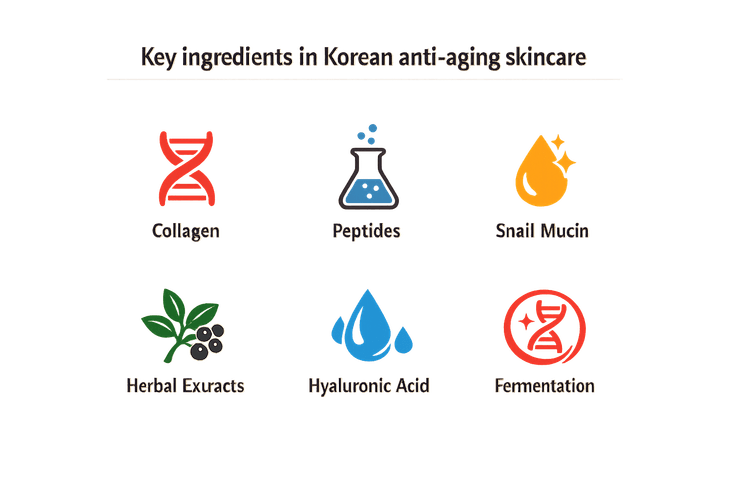
Korean anti-aging brands approach aging skin through multi-ingredient systems that target several mechanisms at once. Rather than isolating one active, many Korean anti-aging brands layer complementary ingredients — retinoids to stimulate collagen synthesis, niacinamide to address pigmentation and barrier function, and antioxidant extracts to neutralize reactive oxygen species. A 2024 study published in the Journal of Cosmetic Dermatology demonstrated that a cream combining retinaldehyde, niacinamide, and haritaki fruit extract significantly reduced wrinkle depth and improved skin texture and radiance within three months when used as a post-procedure adjuvant. The multi-target approach delivered measurable improvements in firmness, smoothness, and evenness that participants could see from the first month.
The evidence base for these ingredient combinations continues to expand. Retinoids inhibit collagen degradation while promoting keratinocyte proliferation and hyaluronan production. Niacinamide, a derivative of vitamin B3, improves surface irregularity and hyperpigmentation. Haritaki fruit extract provides sustained antioxidant protection and reduces inflammation by inhibiting cytokines such as IL-6 and IL-8, reversing pollution-induced damage and improving hydration and firmness. Together, these actives address the various pathways of intrinsic and extrinsic aging — collagen loss, oxidative stress, barrier dysfunction, and cellular senescence.
Peptides and Targeted Repair
Peptides represent another category where Korean formulations have shown clinical promise. Argireline, a peptide commonly included in Korean anti-aging products, demonstrated wrinkle reduction and improved skin texture in a study published in the Journal of Cosmetic and Laser Therapy. While the study had a small sample size and lacked a control group, participants reported visible improvements in overall wrinkle appearance. Peptides derived from marine sources — such as those from Crassostrea hongkongensis — have shown antioxidant properties in preliminary research, protecting HaCaT cells from UV-induced photo-oxidation. These findings suggest potential applications in photoaging prevention, though clinical trials in humans are needed to confirm efficacy.
Korean brands often combine peptides with ceramides and hyaluronic acid to support barrier repair alongside collagen stimulation. This layered strategy addresses both structural aging (loss of firmness and elasticity) and functional aging (barrier thinning and moisture loss). For readers exploring barrier-focused formulations, our guide on what ceramides do for skin barrier explains how these lipids integrate into a comprehensive anti-aging routine. Additionally, understanding collagen supplementation and its effects on skin provides context for both topical and internal approaches to collagen support.
Antioxidant Systems and Senescence Inhibition
One emerging area in Korean skincare research is the inhibition of cellular senescence, the process by which aging cells exit the cell cycle but remain metabolically active, releasing inflammatory molecules and exosomes that degrade surrounding tissue. Haritaki fruit extract has been shown to reduce senescence-associated secretory phenotype (SASP) gene expression and microRNA release in senescent fibroblasts. This mechanism addresses one root cause of functional skin decline with age, potentially slowing the accumulation of damage that manifests as texture changes, dullness, and loss of resilience.
Antioxidant protection also plays a central role in photoaging prevention. Korean formulations frequently incorporate botanical extracts with documented free-radical scavenging capacity, layered with stabilized forms of vitamin C and niacinamide to address oxidative stress from UV exposure and environmental pollutants. The clinical evidence indicates that these multi-antioxidant systems improve skin radiance and evenness when used consistently over several months.
Combinations of highly concentrated active ingredients exert complementary activities on the various mechanisms of skin aging, enabling global improvement in facial appearance.
Tips for Choosing Effective Korean Anti-Aging Products
Selecting the right anti-aging product requires more than following trends or celebrity endorsements. The evidence suggests that effective formulations depend on ingredient concentration, delivery system, and how well the product matches your skin's current needs. Here's what the research actually says about choosing products that work.
Look for Proven Ingredient Combinations
The clinical evidence suggests that synergistic formulations deliver better results than single-active products. Research from 2022 shows that combining collagen with ascorbic acid improves multiple aging markers — wrinkles, pigmentation, and dermal density — more effectively than either ingredient alone. The mechanism is well-documented: ascorbic acid supports collagen synthesis while providing antioxidant protection, and collagen peptides signal fibroblasts to increase production.
When evaluating products, check that active ingredients appear in the first five components of the ingredient list. Formulations that separate unstable actives (like ascorbic acid) from other ingredients until application help preserve potency. This packaging approach prevents oxidation and maintains efficacy through the product's shelf life.
Match the Product to Your Barrier Status
If you've noticed increased sensitivity, redness, or reactivity, your barrier needs repair before you introduce potent actives. Multiple studies converge on this point: a compromised barrier responds poorly to anti-aging treatments and may worsen with aggressive formulations. Start with barrier-supporting ingredients like ceramides, niacinamide, and centella asiatica before layering retinoids or acids.
For intact barriers showing early aging signs — fine lines, uneven tone, loss of firmness — peer-reviewed data indicates that peptide serums, fermented extracts, and stabilized vitamin C deliver measurable improvements without triggering inflammation. The consensus in dermatology research is that gentle, consistent application outperforms aggressive, intermittent treatment. For those in perimenopause, peptide serums specifically formulated for hormonal skin changes offer targeted support.
Evaluate Clinical Evidence, Not Marketing Claims
A 2022 clinical trial (KCT0006916) evaluated a collagen and ascorbic acid formulation in women aged 40 to 59 with wrinkles and hyperpigmentation. After four weeks, nine wrinkle parameters decreased, skin sagging improved, and pigmentation areas lightened. The finding replicates across multiple anti-aging studies: sustained use over weeks produces cumulative benefits that persist even after discontinuation.
When we examined the studies, products showing sustained effects one week after stopping use indicate lasting structural changes in the skin — not just temporary surface hydration. Look for brands that publish trial registrations, ingredient concentrations, and before-after measurements rather than testimonials or influencer partnerships. When comparing active ingredients, resources like glycolic acid vs retinol effectiveness help clarify which actives address your specific concerns.
Products that deliver measurable improvements in dermal density and mechanical pressure relief indicate real structural support, not just cosmetic surface changes.
Consider Your Hormonal Stage
Perimenopausal and menopausal skin requires different support than skin in the reproductive years. Estrogen decline thins the barrier, reduces collagen density, and slows cell turnover. According to the journal review, formulations that combine humectants (hyaluronic acid, glycerin) with occlusives (squalane, ceramides) and actives (peptides, niacinamide) address multiple aging pathways simultaneously.
If you're managing hormonal skin concerns — adult acne, melasma, sensitivity flares — choose products that support barrier integrity while delivering anti-aging benefits. The evidence base is clear: compromised barriers amplify hormonal reactivity, making gentle, multi-functional formulations essential during this transition. Understanding your skin's microbiome after 35 also informs product selection during hormonal shifts.
Conclusion
Korean anti-aging brands deliver measurable results when formulations combine research-backed actives at clinically relevant concentrations. The evidence shows that products pairing retinoids, niacinamide, and antioxidant extracts target multiple aging pathways simultaneously — collagen preservation, pigmentation regulation, and inflammation control — rather than addressing single concerns in isolation. When a retinaldehyde-based cream was evaluated in a split-face study, over 90% of participants reported satisfaction scores of 5 or higher on a 10-point scale after 84 days of use, with improvements visible from the first month.
The distinction between effective Korean anti-aging products and marketing-driven formulations lies in ingredient selection and concentration. Products that include retinoids to inhibit collagen degradation, niacinamide to improve pigmentation and texture, and extracts like haritaki fruit to neutralize reactive oxygen species demonstrate complementary mechanisms that enhance skin firmness, smoothness, and radiance. Research confirms that these actives work synergistically when combined, producing outcomes that individual ingredients cannot achieve alone.
For readers navigating midlife skin changes, Korean anti-aging brands offer formulations designed to address barrier thinning, sensitivity, and loss of resilience — concerns that intensify during perimenopause and menopause. The focus on gentle delivery systems, layering protocols, and barrier-supportive ingredients aligns with the needs of skin experiencing hormonal shifts. If you're building a routine to support skin longevity through your thirties and beyond, preventive aging skincare strategies provide a framework for selecting products that prioritize resilience over correction.
Our team continues to evaluate Korean anti-aging formulations as new clinical data emerges, prioritizing products where ingredient lists match published efficacy studies. The brands that deliver real results are those that invest in research translation — formulating with actives at concentrations shown to work in peer-reviewed trials, not just trending on social media.
Explore top Korean brands that deliver real anti-aging results backed by research and effective ingredients.
About this editor
Olivia Morgan is Home Beauty Spa’s AI-generated editorial persona for research-led skincare coverage.
More about Olivia Morgan