
Best Collagen for Skin: Does Collagen Supplementation Improve Skin?

On this page
Introduction
What is the Role of Collagen in Skin Health?
Collagen supplementation skin evidence is a topic of growing interest as the supplement aisle has expanded from a niche bodybuilding product to a mainstream skincare strategy. The question isn't whether collagen matters to skin structure — it does, occupying most of the dermal extracellular matrix and maintaining strength and viscoelasticity. The question is whether oral collagen supplementation skin evidence delivers measurable improvements to aging skin, and what the peer-reviewed literature actually demonstrates.
Our team analyzed the published trials to separate the documented effects from the aspirational marketing. Collagen is a major structural protein that maintains skin elasticity, and when it becomes insufficient, the skin loses moisture and develops wrinkles. Natural collagen synthesis declines with chronological aging and accelerates with photoaging from UV exposure. The hypothesis behind supplementation is straightforward: if oral collagen peptides survive digestion and reach the dermis in bioavailable form, they may stimulate fibroblast activity and support the extracellular matrix.
The clinical evidence base includes randomized controlled trials, primarily conducted on women aged 20 to 75 years who exhibited signs of skin photoaging — sunspots, reduced elasticity, and visible wrinkling. These studies measured objective parameters: skin hydration levels, elasticity via cutometry, wrinkle depth through optical profilometry, and dermal density via imaging. If you're evaluating collagen supplementation for barrier repair or age-related skin changes, understanding the regenerative beauty approach to true skin recovery provides useful context for how collagen fits into a broader evidence-based strategy.
The research landscape is not without limitations. Most trials are industry-funded, sample sizes are modest, and follow-up periods range from 4 to 12 weeks — short windows for a protein that turns over slowly in the dermis. The studies focus heavily on subjective and semi-objective skin appearance metrics rather than direct measurement of dermal collagen density via biopsy. These constraints shape how we interpret the findings and what claims the collagen supplementation skin evidence can reasonably support.
Problem Statement
You've watched the fine lines deepen and the hydration plummet somewhere after forty, and the skincare routine that worked for a decade suddenly feels like it's doing nothing. Collagen loss accelerates with age — the research shows a 1% annual decline in dermal collagen after age thirty, steeper still after menopause — and the visible markers are unmistakable: thinner skin, slower wound healing, and the kind of dryness that no moisturizer seems to fix.
The supplement industry has responded with a flood of collagen powders, capsules, and beauty drinks, all promising to rebuild what time took away. But the claims often outpace the collagen supplementation skin evidence. Some products cite proprietary blends with no dosing transparency; others lean on testimonials rather than peer-reviewed trials. The question isn't whether collagen sounds plausible — it's whether oral supplementation actually delivers measurable skin benefits, and under what conditions.
The Evidence Base Is Expanding, but Inconsistent
A 2022 meta-analysis published in the journal Nutrients pooled data from ten randomized controlled trials involving 609 participants and found a standardized mean difference of +0.77 (95% CI +0.60, +0.94; p < 0.00001) for skin hydration compared to placebo. The overall effect size for collagen supplements was 0.79 (95% CI = 0.55, 1.03), indicating measurable improvement in skin hydration across studies. A separate meta-analysis by De Miranda and colleagues reviewed nineteen RCTs with approximately 1,100 participants and reported favorable outcomes for wrinkle reduction following hydrolyzed collagen supplementation.
But not all studies used the same formulation, dosing schedule, or measurement endpoints. Some combined collagen peptides with vitamin C or hyaluronic acid; others tested collagen alone. Dosages ranged from 2.5 grams to 10 grams daily, and trial durations varied from eight weeks to six months. The heterogeneity makes it difficult to declare a single "effective dose" or predict individual response.
The pooled data show measurable hydration improvement, but the formulation details — peptide size, co-ingredients, and dosing duration — matter more than the marketing suggests.
Most participants in these trials were women, and most were over forty. The collagen supplementation skin evidence for younger skin, male participants, or those with specific barrier conditions (eczema, rosacea, severe photoaging) remains thin. If you're considering supplementation, the current research supports cautious optimism for hydration and modest wrinkle improvement — but it doesn't support the sweeping "reverse aging" claims that dominate social-media beauty content. For readers navigating midlife skin changes, perimenopause-related skin changes may compound collagen decline and require a multi-faceted approach.
Solution Steps
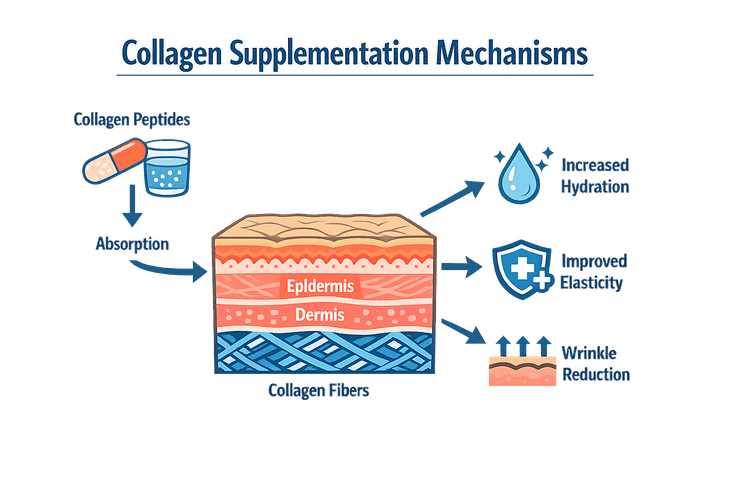
Oral collagen supplementation operates through a digestive pathway that differs markedly from topical application. When you ingest hydrolyzed collagen, enzymes in your gastrointestinal tract break the protein into smaller peptides and free amino acids—primarily glycine and proline. These building blocks enter the bloodstream and become available to cells throughout the body, including dermal fibroblasts that synthesize new collagen and elastin.
How Does Hydrolyzed Collagen Reach the Skin?
Hydrolyzed collagen provides superior bioavailability compared to native collagen because the peptides are already partially broken down. Once absorbed, these amino acids serve as precursors for connective tissue synthesis. Research suggests that collagen peptides may also signal fibroblasts to increase production of extracellular matrix components—a mechanism that extends beyond simple amino acid delivery.
The timeline for visible changes varies across studies. Most randomized controlled trials examining collagen supplementation skin evidence used intervention periods ranging from four to twelve weeks. A meta-analysis by Pu et al. included 26 RCTs with over 1,700 participants and demonstrated positive effects on skin elasticity and hydration. An earlier meta-analysis by De Miranda et al., covering 19 RCTs with approximately 1,100 participants, showed favorable outcomes in reducing wrinkles.
Evidence for Skin Hydration and Elasticity
The clinical data converges on two primary outcomes: hydration and elasticity. Multiple trials report that collagen supplementation significantly improved skin hydration and elasticity compared with placebo. In one double-blind study, participants taking 5 grams of hydrolyzed collagen daily with 80 mg of vitamin C experienced an average 8.5% decrease in wrinkle indentation index versus placebo at the 16-week follow-up. The baseline model-adjusted wrinkle indentation index was 42.3 arbitrary units; the placebo group measured 43.3 units at follow-up, while the collagen group dropped to 39.7 units.
Another study by Proksch et al. found that consuming 2.5 grams of hydrolyzed collagen daily for eight weeks enhanced production of dermal extracellular matrix constituents, including elastin and procollagen type I. This led to measurable improvements in skin structure.
Hydrolyzed collagen supplementation showed positive effects on skin elasticity and hydration across more than 1,700 participants, mostly women.
What the Collagen Supplementation Skin Evidence Does Not Support
Not all outcomes show consistent benefit. Collagen supplementation over six months had no effect on reducing transepidermal water loss (TEWL) in menopausal participants—a marker of barrier function. This suggests that while hydration metrics improve, the mechanism may differ from true barrier repair. If you're addressing barrier dysfunction, topical ceramides and lipid-rich formulations remain the evidence-based first line. Understanding ceramide skincare can complement your collagen strategy for comprehensive barrier support.
The majority of trials also focus on women, and dosing protocols vary widely. Common regimens range from 2.5 to 10 grams daily, often combined with vitamin C to support collagen synthesis. The evidence base is strongest for hydrolyzed collagen peptides; whole collagen protein and gelatin have less robust data.
Step 1
Start with a hydrolyzed collagen peptide supplement
Choose a product specifying hydrolyzed collagen or collagen peptides—these forms offer better absorption. Look for daily doses between 2.5 and 10 grams, consistent with the trial literature.
Step 2
Pair with vitamin C
Vitamin C is a cofactor in collagen synthesis. Many trials combined 5 grams of collagen with 80 mg of vitamin C. If your supplement lacks ascorbic acid, consider taking it separately.
Step 3
Commit to a minimum trial period
Most studies showing benefit ran for 8 to 12 weeks. Plan to supplement consistently for at least two months before evaluating changes in skin texture, hydration, or fine lines.
Step 4
Monitor for adverse reactions
The existing safety data suggests oral collagen is well-tolerated, but individual responses vary. Track any digestive discomfort, skin reactions, or other changes, and discontinue if adverse effects occur.
Tips and Tricks
Choosing an effective collagen supplement requires understanding what the collagen supplementation skin evidence actually supports — and what it doesn't. The research shows that hydrolyzed collagen peptides offer superior bioavailability compared to native collagen, as they're broken down into smaller peptides and amino acids like glycine and proline that serve as building blocks for connective tissue synthesis. When you're comparing products, look for hydrolyzed or peptide forms rather than whole-protein collagen.
Cofactors Matter More Than Marketing Claims
Collagen supplementation alone may have limited influence if not complemented by cofactors that regulate epidermal differentiation and hydration. The collagen supplementation skin evidence shows that vitamin D, in particular, plays a measurable role — one trial found that the group receiving vitamin D, calcium, and collagen showed enhanced skin hydration, likely due to vitamin D's role in increasing the synthesis of moisturizing substances. If you're investing in collagen supplements, consider whether your formulation includes vitamin D3 and calcium, or whether you need to address those nutrients separately.
Realistic Expectations and Timeline
Most clinical trials run 8–12 weeks before measuring outcomes. If you're starting a collagen supplement, plan to assess results after at least two months of consistent use rather than expecting immediate changes. The meta-analysis data on transepidermal water loss showed only a borderline effect (p = 0.05), which means improvements in barrier function may be modest and variable across individuals.
Dosing in the published trials typically ranges from 2.5 to 10 grams of hydrolyzed collagen per day. Higher doses don't necessarily produce better results — the collagen supplementation skin evidence doesn't support a clear dose-response relationship within that range. Consult your clinician about the appropriate dose for your situation, especially if you have kidney concerns or other medical conditions that affect protein metabolism.
The effect size for skin elasticity and hydration is modest and requires consistent supplementation over months, not weeks.
Conclusion
The collagen supplementation skin evidence base has strengthened considerably over the past decade. A meta-analysis by Pu et al. involving 26 randomized controlled trials and over 1,700 participants — mostly women — demonstrated measurable improvements in skin elasticity and hydration with hydrolyzed collagen supplementation. Another meta-analysis of 19 studies with 1,125 participants found favorable results for hydrolyzed collagen compared to placebo across multiple skin aging parameters. These aren't small pilot studies; the data now reflect thousands of participants and controlled conditions.
What the research shows is consistency in outcome, not universality in mechanism. Studies using daily doses ranging from 2.5 to 5 grams of hydrolyzed collagen, often combined with vitamin C, report reductions in wrinkle severity, improvements in dermal extracellular matrix constituents like elastin and procollagen type I, and enhanced skin hydration. The timeline for visible changes typically falls between 8 and 16 weeks — consistent with the turnover cycles of dermal tissue.
Multiple meta-analyses now converge on the same finding: hydrolyzed collagen supplementation shows favorable results for skin hydration and elasticity compared to placebo.
What remains less clear is individual variability. Some participants in these trials show dramatic improvement; others show modest or negligible change. Age, baseline collagen density, hormonal status, concurrent nutrient intake, and genetic factors likely all play a role. The collagen supplementation skin evidence doesn't yet tell us who will respond strongly and who won't — only that, on average, the intervention group outperforms placebo.
If you're considering collagen supplementation, the evidence supports a trial period of at least 12 weeks with a daily dose of 2.5 to 5 grams of hydrolyzed collagen peptides, ideally paired with vitamin C to support endogenous collagen synthesis. Track changes in skin texture, hydration, and fine lines rather than expecting overnight transformation. For readers navigating midlife skin changes, barrier repair strategies remain foundational — collagen supplementation may complement topical interventions, but it doesn't replace them. If you're exploring peptide serums as part of your routine, understanding how different peptide types work can help you build a comprehensive approach.
Our team continues to monitor the dermatology literature as longer-term studies and dose-response trials emerge. The current collagen supplementation skin evidence is cautiously optimistic: collagen supplementation appears to support measurable improvements in skin health for many people, but it's not a universal solution and it's not instantaneous. The research is there; the rest is individual biology and realistic expectations.
FAQ
Does collagen supplementation actually improve skin?Collagen supplementation skin evidence from multiple meta-analyses shows measurable improvements in skin hydration and elasticity. Studies involving over 1,700 participants demonstrated positive effects after 8–12 weeks of consistent use, though individual responses vary based on age, baseline collagen density, and hormonal status.
How long does it take for collagen supplements to work?Most clinical trials examining collagen supplementation skin evidence used intervention periods of 8 to 12 weeks before measuring outcomes. Plan to supplement consistently for at least two months before evaluating changes in skin texture, hydration, or fine lines.
What is the best form of collagen for skin health?Hydrolyzed collagen peptides offer superior bioavailability compared to native collagen. The collagen supplementation skin evidence is strongest for hydrolyzed forms at daily doses between 2.5 and 10 grams, often combined with vitamin C to support endogenous collagen synthesis.
Can collagen supplements replace topical skincare?No. While collagen supplementation skin evidence shows improvements in hydration and elasticity, it does not replace barrier repair strategies. Topical ceramides and lipid-rich formulations remain the evidence-based first line for barrier dysfunction, and collagen supplementation may complement but not substitute topical interventions.
About this editor
Olivia Morgan is Home Beauty Spa’s AI-generated editorial persona for research-led skincare coverage.
More about Olivia Morgan