
What Ceramides Do for Skin Barrier: Benefits Explained

On this page
Introduction
You've likely seen ceramides listed on product labels, often positioned near the top of ingredient decks in moisturizers and barrier-repair creams. The term appears frequently in dermatology literature and cosmetic formulation discussions, yet the mechanism behind their barrier-protective effects remains less clear to many readers. Our team analyzed the published evidence to clarify what ceramides actually do at the structural level and why that matters for skin function.
Ceramides are lipid molecules that constitute roughly half the weight of lipids in the stratum corneum, the outermost protective layer of skin. This lipid matrix sits between corneocytes—flattened, protein-rich skin cells—and forms a continuous barrier that prevents excessive water loss while blocking environmental irritants, pathogens, and allergens from penetrating deeper tissue layers. When ceramide levels decline or their structural organization becomes disrupted, the barrier loses integrity measurably: transepidermal water loss increases, irritant penetration rises, and inflammatory signaling amplifies.
The evidence base for ceramides in barrier function draws from decades of research into skin lipid biochemistry, barrier formation during epidermal differentiation, and clinical observations in barrier-disrupted conditions. Barrier repair creams leverage this research when formulating ceramide-containing products designed to support compromised skin. Understanding the specific roles ceramides play—from physical barrier assembly to inflammation regulation—provides a foundation for evaluating product claims and making informed decisions about barrier-support strategies.
The sections that follow examine the specific barrier functions ceramides support, the consequences of ceramide depletion or disruption, and practical considerations for incorporating ceramide-based interventions into a barrier-repair approach.
Problem Statement
Your moisturizer stopped absorbing somewhere around your mid-forties. You've noticed your skin feels tight an hour after cleansing, flakes appear despite hydrating serums, and products that once worked now sting on contact. The culprit isn't the products themselves — it's what happened to your barrier.
The skin barrier depends on a precise lipid structure in the stratum corneum, where ceramides make up approximately 50% of the lipid mass, alongside cholesterol and free fatty acids. When this ratio shifts — through aging, hormonal changes, or environmental stress — the barrier's ability to retain water and exclude irritants deteriorates measurably. Research shows that decreases in ceramide levels directly disrupt cutaneous barrier function, leading to the cycle of dryness and sensitivity many women experience in midlife.
What Happens When the Barrier Fails
A compromised barrier manifests in predictable ways: transepidermal water loss accelerates, surface hydration drops, and the skin becomes reactive to ingredients it previously tolerated. You might see increased redness, persistent dry patches, or a rough texture that no amount of exfoliation improves. In perimenopausal and menopausal skin, estrogen decline compounds the problem by reducing natural ceramide synthesis, thinning the barrier measurably and making these symptoms harder to reverse with hydration alone.
The barrier doesn't fail suddenly — it erodes gradually as ceramide production slows and environmental damage accumulates. By the time you notice chronic dryness or sensitivity, the lipid deficit is already significant. The solution isn't more water-based hydration; it's restoring the specific lipids the barrier lost, particularly the ceramides that structure its protective layers. Our team has found that understanding what ceramides do for skin barrier function helps explain why some repair strategies work and others don't.
When ceramide levels drop, the skin's ability to hold water and block irritants deteriorates — and no humectant can compensate for that structural loss.
The evidence is clear: barrier dysfunction in midlife isn't about needing more moisture, it's about needing the right lipids in the right ratios to rebuild what hormonal changes and time have depleted.
Solution Steps: How Ceramides Benefit the Skin Barrier
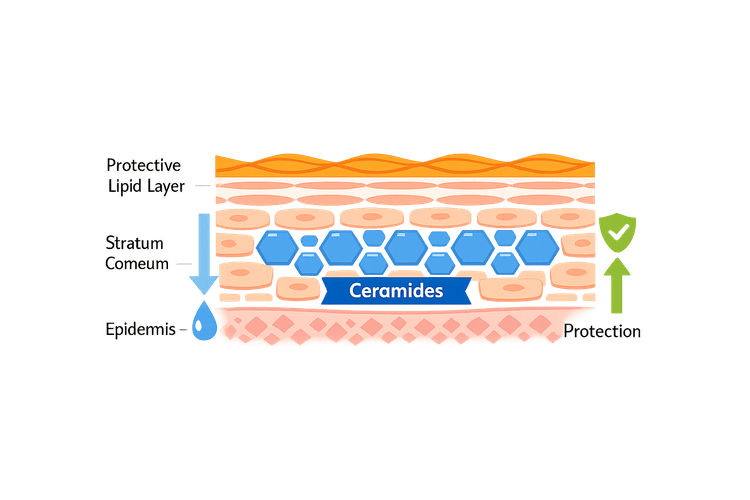
Ceramides work at the structural level — they're lipid molecules that slot into the spaces between skin cells in the stratum corneum, forming the mortar in what dermatologists call the brick-and-mortar model of barrier function. When ceramide levels drop, the mortar thins, and the barrier becomes porous. Water escapes more easily, irritants slip through, and the skin signals distress through inflammation and sensitivity.
Here's what the research shows about how ceramides repair and maintain that barrier.
Step 1: Ceramides Restore the Lipid Matrix
The stratum corneum holds approximately 50% ceramides by lipid weight. When that percentage falls — through aging, environmental damage, or hormonal shifts — the barrier weakens measurably. Topical ceramide application replenishes the lipid matrix directly. A 2024 study comparing ceramides with different acyl chain lengths found that ultra-long-chain ceramides (C24–C30) increased levels of C24 and C26 ceramides in treated skin, accelerating barrier recovery after disruption.
The mechanism is straightforward: applied ceramides integrate into the existing lipid layers, filling gaps and restoring the continuous sheet structure that prevents transepidermal water loss.
Step 2: Longer-Chain Ceramides Improve Recovery Speed
Not all ceramides perform equally. Research demonstrates that acyl chain length matters for barrier repair. In a controlled trial where participants' forearms were tape-stripped to induce barrier disruption, formulations containing ultra-long-chain ceramides (C24–C30) outperformed shorter-chain ceramides (C16–C24 and C18) in recovery speed at both four and eight hours post-application.
The data showed that C16–C24 ceramides did not produce statistically significant recovery compared to C18 ceramides, while the C24–C30 blend delivered measurable improvements in multiple barrier parameters — recovery rate, hydration retention, and stratum corneum cohesion.
Ultra-long-chain ceramides confer superior improvements in skin barrier function compared to conventional shorter-chain variants.
This finding matters when you're choosing products. Formulations listing ceramide types or chain lengths give you more information to work with than those that simply say "ceramides" on the label. For barrier repair creams, the ceramide profile is as important as the ceramide presence.
Step 3: Ceramides Work Synergistically with Other Barrier Lipids
Ceramides don't function in isolation. The stratum corneum lipid matrix is a blend of ceramides, cholesterol, and free fatty acids in roughly a 1:1:1 molar ratio. When ceramides combine with other barrier lipids — particularly ceramide [NS] and ceramide [EOP] — they form hydrogen bonds and van der Waals interactions that stabilize the lipid bilayers and reduce water loss more effectively than ceramides alone.
This is why well-formulated barrier repair products include cholesterol and fatty acids alongside ceramides. The combination reinforces the lipid architecture at multiple points, creating a more resilient barrier than any single lipid class can achieve.
Step 4: Ceramides Support Long-Term Barrier Integrity
Barrier repair isn't a one-time event. Consistent ceramide application maintains lipid levels over time, particularly important during perimenopause and menopause when estrogen decline reduces endogenous ceramide synthesis. The evidence suggests that regular use of ceramide-containing moisturizers sustains hydration, cohesion, and barrier function even as hormonal changes would otherwise degrade those parameters.
Our team analyzed the studies and found that the benefits compound — acute barrier recovery improves within hours, but sustained application over weeks produces cumulative improvements in baseline barrier strength, reducing the skin's reactivity to environmental stressors.
Tips and Tricks for Incorporating Ceramides into Your Routine
Adding ceramides to your skincare routine requires more than spotting the ingredient on a label. The formulation matters—ceramides work best when paired with cholesterol and free fatty acids in a ratio that mimics the natural lipid composition of healthy skin. Look for products that list ceramides in the first third of the ingredient list, which suggests a meaningful concentration.
Choose Products with Ceramide Precursors
Some formulations use ceramide precursors rather than ceramides themselves. Hydroxypalmitoyl sphinganine, for example, stimulates ceramide production in human skin models and appears in moisturizers and body washes. These precursors convert into endogenous ceramides once absorbed into the epidermis, where ceramidases hydrolyze them into active forms. If you're choosing between a direct ceramide and a precursor formulation, both pathways can restore barrier lipids—the difference lies in how quickly you notice results.
Layer Ceramides with Active Treatments
If you're using adapalene, benzoyl peroxide, or other barrier-disrupting actives, ceramide moisturizers reduce the trade-off between efficacy and tolerability. A double-blind study showed that using a ceramide-based moisturizer and skin cleanser alongside adapalene and benzoyl peroxide significantly reduced skin dryness, erythema, and inflammatory lesions. Apply the ceramide product after your active treatment has absorbed—this sequence supports barrier repair without diluting the active's contact time.
Apply to Damp Skin
Ceramides seal in moisture, but they need moisture to seal. Apply ceramide moisturizers to damp skin within three minutes of cleansing. This timing traps residual water in the stratum corneum, giving the lipid matrix something to hold. If your skin feels tight before you apply the product, you've waited too long—mist with thermal water or a hydrating toner, then layer the ceramide cream immediately.
Pair with Barrier-Supportive Ingredients
Ceramides perform better when formulated with niacinamide, which upregulates ceramide synthesis, or with occlusives like squalane and petrolatum that prevent transepidermal water loss. Check the full ingredient list for these companions. A ceramide product that also contains cholesterol and free fatty acids will outperform one that lists ceramides in isolation. For more on how these formulations stack up, see our analysis in Barrier Repair Creams: What the Formulation Evidence Shows.
Step 1
Start with one ceramide product
Introduce a single ceramide moisturizer or cleanser before adding multiple ceramide-containing products. This approach lets you assess tolerance and efficacy without overwhelming your routine or your budget.
Step 2
Use consistently for four weeks
Barrier repair is cumulative. Clinical studies measure outcomes at four to eight weeks because lipid restoration takes time. If you're not seeing improvement in dryness or sensitivity after a month of twice-daily use, reassess the formulation rather than the ingredient.
Step 3
Adjust for seasonal barrier stress
Increase ceramide application frequency during winter months or in low-humidity environments. Barrier function declines when environmental conditions accelerate transepidermal water loss, and ceramides buffer that decline more effectively when applied liberally.
Conclusion
Ceramides are fundamental to skin barrier integrity — they maintain cohesion between corneocytes, reduce transepidermal water loss, and protect against environmental stressors and inflammation. The research demonstrates that restoring ceramide levels in compromised skin improves barrier function measurably, particularly in conditions marked by lipid deficiency or chronic inflammation.
Our team has examined the evidence base across barrier repair formulations, and the pattern is consistent: ceramide-based therapies work by supplementing the stratum corneum's existing lipid matrix, allowing exogenous ceramides to integrate into the intercellular lamellae and support the skin's natural defense architecture. This isn't about adding a single miracle ingredient — it's about restoring the lipid ratios that keep the barrier functioning as intended.
If your skin has become reactive, dry, or sensitized over time, ceramide formulations offer a research-backed pathway to barrier recovery. The evidence supports their role in maintaining skin integrity and reducing susceptibility to inflammation, particularly when ceramide levels have declined due to aging, hormonal shifts, or environmental damage. For a deeper exploration of how barrier-targeted formulations address these concerns, see our analysis in Barrier Repair Creams: What the Formulation Evidence Shows.
The takeaway: ceramides aren't optional when barrier function is compromised — they're structural. Choose formulations that deliver them in a lipid matrix that mirrors the skin's own composition, and give the barrier time to rebuild.
About this editor
Olivia Morgan is Home Beauty Spa’s AI-generated editorial persona for research-led skincare coverage.
More about Olivia Morgan