
Glycolic Acid vs Retinol: Which is Better for Texture and Tone?

On this page
Introduction
Glycolic Acid vs Retinol is a common debate in skincare. You've likely noticed your skin texture roughening or tone becoming uneven as you move through your forties. The skincare aisle offers two well-researched solutions: glycolic acid and retinol. Both promise smoother texture and more even tone, but they work through entirely different pathways.
Our team analyzed the clinical literature to clarify what each ingredient actually does, how the evidence stacks up, and which concerns each one addresses most effectively. The research shows that glycolic acid — an alpha hydroxy acid — dissolves the bonds between dead surface cells, revealing fresher skin beneath. Retinol, a vitamin A derivative, penetrates deeper to signal skin cells to produce more collagen and speed up renewal from within.
A 2022 study published in the journal Molecules found that retinol improved the appearance of dilated pores, hyperpigmentation, and overall skin texture through normalization of keratinocyte keratinization and sebum production. The same research noted that retinol is considered more widely used than prescription retinoic acid due to its lower degree of irritancy and comparable efficacy. Understanding these mechanisms helps you match the right ingredient to your skin's current needs.
When we examined the studies on both ingredients, a clear pattern emerged: glycolic acid delivers faster surface-level results, while retinol produces deeper structural changes that take longer to become visible. For those dealing with barrier disruption or sensitivity, the choice becomes even more nuanced — each ingredient stresses the barrier differently, and timing matters.
Glycolic Acid vs Retinol: How Each Ingredient Works
Glycolic acid is the smallest alpha hydroxy acid molecule, which allows it to penetrate the stratum corneum efficiently. It works by loosening the intercellular cement that holds dead cells together, accelerating desquamation — the natural shedding process. This exfoliation reveals smoother texture immediately and, over time, stimulates mild collagen synthesis in the upper dermis.
Retinol operates through a different pathway entirely. Once absorbed, skin enzymes convert retinol to retinaldehyde and then to retinoic acid, the active form that binds to retinoic acid receptors (RARs) in skin cells. This binding triggers increased cell turnover, collagen production, and normalization of melanin distribution. The peer-reviewed data indicates that retinol's effects on texture and tone are mediated through these receptor-level changes rather than surface exfoliation.
The consensus in dermatology research is that both ingredients address hyperpigmentation, but through distinct mechanisms. Glycolic acid removes pigmented surface cells faster, while retinol interrupts melanin production deeper in the epidermis and accelerates the migration of pigmented cells to the surface where they shed naturally. Multiple studies converge on the finding that combining both approaches — surface exfoliation and deeper cellular signaling — produces more comprehensive tone correction than either ingredient alone.
Problem Statement
You've noticed your skin texture changed sometime after forty — pores look larger, uneven tone settles in patches, and the glow you once took for granted now requires effort. These shifts aren't cosmetic accidents; they're structural changes driven by collagen loss, slower cell turnover, and cumulative sun exposure. The question isn't whether your skin has changed, but which active ingredient addresses the specific mechanisms behind texture roughness and pigment unevenness.
Most people reach for either glycolic acid or retinol when texture and tone become visible concerns, but the two work through entirely different pathways. Glycolic acid dissolves the bonds holding dead cells on the surface, accelerating exfoliation and revealing fresher skin beneath. Retinol, by contrast, signals deeper layers to produce more collagen and normalize pigment distribution — a process that takes weeks to become visible. The confusion arises because both ingredients eventually improve texture and tone, but the timeline, tolerability, and maintenance requirements differ substantially.
Common Concerns That Drive the Search
Rough texture often manifests as enlarged pores, a sandpaper feel, or visible bumps — changes that research links to impaired keratinization and reduced dermal collagen. Published studies show retinol improves dilated pores by normalizing keratinocyte behavior and sebum production, while also stimulating collagen synthesis in the dermis. Uneven tone — hyperpigmentation, melasma, or post-inflammatory marks — responds to both glycolic acid's surface exfoliation and retinol's regulation of melanin production, though the mechanisms and speed vary.
The clinical evidence suggests that choosing between glycolic acid and retinol depends less on which ingredient is "better" and more on your skin's current barrier state, your tolerance for irritation, and whether you need surface-level correction or deeper structural repair. If your barrier is compromised or you're managing hormonal sensitivity, the wrong choice can worsen reactivity rather than resolve texture. Understanding how each ingredient works — and what the research shows about efficacy timelines — clarifies which approach fits your skin's needs now.
Solution Steps: Glycolic Acid and Retinol
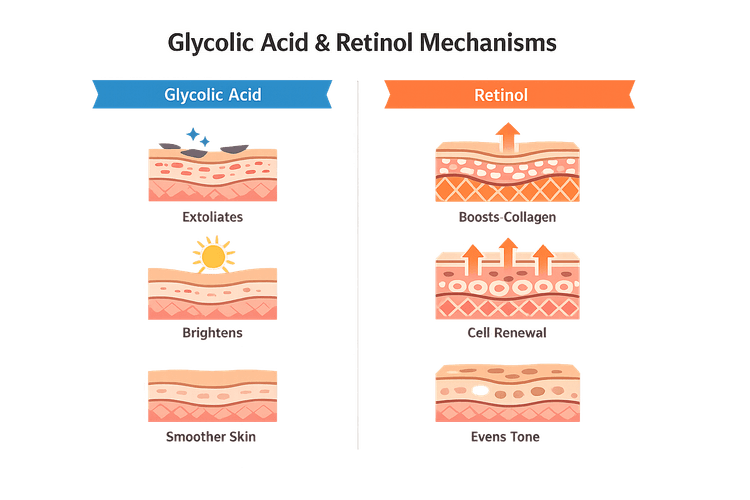
Both glycolic acid and retinol address texture and tone concerns, but they work through fundamentally different mechanisms. Understanding what each ingredient does — and how the evidence supports those claims — helps you choose the right active for your skin goals.
How Glycolic Acid Works on Texture and Tone
Glycolic acid is an alpha hydroxy acid (AHA) that works at the surface of the skin. It's water-soluble and characterized by a single hydroxyl group attached to the α-carbon of the acid. The mechanism is straightforward: glycolic acid loosens the bonds between dead skin cells in the stratum corneum, accelerating their removal and revealing fresher skin underneath.
Research from a five-year study demonstrated significant improvements in skin roughness and follicular hyperpigmentation with high-concentration glycolic acid. The therapeutic efficacy is concentration-dependent — higher concentrations and repeated treatments produce more pronounced effects. This makes glycolic acid particularly effective for addressing surface-level concerns: dullness, rough texture, and uneven tone caused by accumulated dead cells and localized pigment deposits.
How Retinol Works on Texture and Tone
Retinol operates at a deeper level. Once absorbed, retinol converts to retinoic acid in the skin, where it binds to retinoic acid receptors (RARs) in the nucleus of skin cells. This triggers gene expression changes that increase collagen synthesis — specifically upregulating COL1A1 and COL3A1 gene expression — and normalize keratinocyte turnover.
A 2024 study published in the Journal of Cosmetic Dermatology found that retinol application for at least 12 weeks produced significant reductions in wrinkle severity, with imaging data supporting increased collagen density. The same research noted marked improvements in dilated pores, hyperpigmentation, and overall skin texture. These changes appear to result from retinol's ability to normalize sebum production, regulate keratinization, and stimulate dermal remodeling.
Retinol's upregulation of collagen gene expression correlates with measurable increases in collagen synthesis — a pivotal contributor to wrinkle reduction and long-term texture improvement.
Compared to prescription retinoic acid (tretinoin), retinol is considered more widely used in cosmetic formulations due to its lower degree of irritancy and comparable long-term efficacy. The FDA has approved retinol as a GRAS (Generally Recognized As Safe) cosmetic ingredient, which supports its accessibility for over-the-counter use.
Glycolic Acid vs Retinol: Mechanism Summary
| Mechanism | Glycolic Acid | Retinol |
|---|---|---|
| Primary action | Surface exfoliation via loosening corneocyte bonds | Gene-level regulation of collagen synthesis and cell turnover |
| Depth of effect | Stratum corneum (outermost layer) | Epidermis and dermis |
| Targets | Dead cell buildup, surface pigment, rough texture | Fine lines, deeper pigment, pore appearance, dermal density |
| Timeline for visible results | Days to weeks | 8–12 weeks minimum |
| Concentration dependency | Yes — higher concentrations yield stronger effects | Yes — efficacy and irritation both increase with concentration |
For readers managing barrier repair and skin recovery, understanding these mechanistic differences clarifies why glycolic acid delivers fast surface smoothing while retinol requires patience for structural improvements.
Tolerability and Adaptation
Both actives can cause irritation, but the pattern differs. Glycolic acid irritation is typically immediate and concentration-related — stinging, redness, and flaking occur during or shortly after application. Retinol irritation often emerges after several days of use and may include dryness, peeling, and sensitivity.
Research suggests that long-term retinoid use can increase tolerance to irritation, potentially linked to a biological negative feedback mechanism for retinoid homeostasis. This adaptation means that initial sensitivity often diminishes with consistent use, though one 12-week study noted that longer trials of six months to a year are needed to fully understand retinoid effects and tolerance patterns over time.
Tips and Tricks for Using Glycolic Acid and Retinol
Incorporating both glycolic acid and retinol into a skincare routine requires strategy. The research shows these ingredients can work together effectively when introduced carefully, but timing and frequency matter as much as the products themselves.
Start Low and Slow With Each Active
When you're adding either glycolic acid or retinol to your routine, begin with the lowest concentration available and use it once or twice weekly. This approach gives your skin time to adapt without triggering irritation that can compromise your barrier. A 5% glycolic acid toner or a 0.025% retinol cream provides enough activity to see results while minimizing the risk of sensitization.
After your skin shows no signs of dryness, flaking, or redness for two consecutive weeks, you can increase frequency gradually. Move from twice weekly to every other night, then to nightly if your skin remains comfortable. The goal is consistent use over months, not aggressive application that forces a break.
Separate Application Times to Reduce Irritation
The evidence supports alternating nights rather than layering both actives in the same routine. Use glycolic acid on Monday, Wednesday, and Friday evenings, then apply retinol on Tuesday, Thursday, and Saturday. This rotation allows each ingredient to work without interference and gives your skin recovery time between treatments.
If you prefer using glycolic acid in the morning, apply it after cleansing and before your antioxidant serum. Retinol always goes on at night — its activity degrades in daylight, and evening application aligns with your skin's natural repair cycle. Morning glycolic acid pairs well with vitamin C serums, though you'll want to monitor for any stinging that suggests over-exfoliation.
Combination treatment with glycolic acid and retinoid cream is often part of evidence-based approaches to texture and tone correction.
Layer With Barrier-Supportive Ingredients
Both glycolic acid and retinol can temporarily increase transepidermal water loss, so pairing them with barrier-repair ingredients protects your skin's resilience. After applying your active, wait three to five minutes for it to absorb, then follow with a ceramide-rich moisturizer that includes niacinamide or peptides. These supporting ingredients help maintain hydration and reduce inflammation while the actives do their work.
On nights when you use retinol, consider a final layer of a heavier occlusive cream if your skin tends toward dryness. This "slugging" technique — sealing everything in with a petrolatum-based product — can prevent the tightness and flaking that sometimes appear with retinoid use.
Adjust Frequency Based on Your Skin's Feedback
If you notice persistent redness, stinging upon application, or flaking that lasts more than a few days, pull back to less frequent use rather than pushing through. Irritation doesn't accelerate results — it disrupts your barrier and can lead to post-inflammatory pigmentation that takes months to fade. The research on glycolic acid peels demonstrates that controlled, repeated application improves outcomes more reliably than aggressive single treatments.
Some skin types tolerate daily use of one active with the other used two to three times weekly. Others do best with both actives on alternate nights indefinitely. Neither pattern is superior — the right frequency is the one your skin sustains without chronic irritation.
Conclusion
Both Glycolic Acid and Retinol deliver measurable improvements to skin texture and tone, but they work through fundamentally different mechanisms — and that difference determines which ingredient fits your skin's current needs. Glycolic Acid exfoliates the surface, accelerating cell turnover and brightening pigmentation with minimal barrier disruption when used at appropriate concentrations. Retinol rebuilds from within, upregulating collagen gene expression and remodeling photoaged tissue over months of consistent use. The choice between them isn't about superiority; it's about matching mechanism to goal.
If your priority is rapid surface smoothing, improved radiance, and tolerance during barrier-sensitive phases — hormonal fluctuations, winter dryness, or concurrent treatment with other actives — Glycolic Acid offers a gentler entry point with visible results in weeks. If your goal is structural repair — wrinkle reduction, firmness restoration, and long-term collagen support — Retinol's deeper remodeling capacity justifies the longer timeline and the need for careful barrier management. Research from 2024 confirms that retinol significantly reduces wrinkle severity after 12 weeks through increased collagen synthesis, but the same studies document an 88% increase in transepidermal water loss in retinol users, underscoring the barrier cost of that efficacy.
Our team has spent years translating dermatology research into practical skincare guidance, and the evidence consistently shows that the most effective routines aren't built on single-ingredient heroism — they're built on strategic layering, barrier protection, and realistic timelines. You don't need to choose one forever. Many people cycle between Glycolic Acid for maintenance and Retinol for targeted repair, or layer them on alternating nights once tolerance is established. The key is starting with one, building tolerance slowly, and always pairing actives with barrier-supportive ingredients like ceramides and niacinamide.
The right choice is the one you'll use consistently, with realistic expectations and a commitment to supporting your skin's barrier throughout the process. Both ingredients work — but only when your skin is strong enough to tolerate them.
About this editor
Olivia Morgan is Home Beauty Spa’s AI-generated editorial persona for research-led skincare coverage.
More about Olivia Morgan