
The Best Korean Serums for Wrinkles and Fine Lines

Top takeaways
- Korean serums combine traditional botanical extracts with clinically studied actives like peptides, niacinamide, and retinol to address wrinkles and fine lines
- The Korean beauty industry emphasizes layering lightweight formulations that deliver concentrated active ingredients without overwhelming the skin barrier
- Evidence-based ingredient selection matters more than brand origin — understanding what each active does helps you choose serums that match your skin's current needs
- Midlife skin changes require formulations that support barrier integrity while delivering anti-aging benefits, a balance Korean serums often prioritize
On this page
Introduction
You've noticed the fine lines deepening around your eyes, the texture shifting across your cheeks. The moisturizer that worked for years suddenly feels inadequate. Korean serums have gained attention for addressing exactly these concerns — but the marketing often outpaces the evidence.
The Korean beauty industry built its reputation on formulation innovation, combining traditional botanical ingredients with modern active compounds. In our exploration of Korean skincare serums, particularly those aimed at addressing wrinkles and fine lines, our team delves into the intricate world of active ingredients, cross-referencing findings from various studies to assess consistency and efficacy. These serums typically feature lighter textures than Western counterparts, designed for layering multiple products without barrier disruption.
What sets effective anti-wrinkle serums apart isn't their country of origin — it's the active ingredients they deliver and the concentrations at which they're formulated. Korean serums often spotlight peptides, niacinamide, adenosine, and fermented extracts alongside more familiar actives like retinol and vitamin C. Understanding which ingredients target which mechanisms of aging helps you move past the packaging and into evidence-based choices.
For those experiencing perimenopausal and menopausal skin changes — when estrogen decline measurably thins the barrier and reduces collagen synthesis — choosing serums becomes more complex. Your skin may react differently to actives it once tolerated. The goal shifts from chasing the newest launch to finding formulations that deliver results without triggering sensitivity. For a broader perspective on maintaining skin resilience during this transition, see our guide on preventive aging skincare for building resilience in your 30s.
This article examines the active ingredients most commonly featured in Korean anti-wrinkle serums, the mechanisms by which they work, and how to evaluate whether a given formulation matches your skin's current needs. We'll address the gap between what the research actually shows and what the product descriptions promise.
Problem Statement
You've noticed the texture changing — those fine lines that catch the light differently now, the crepiness that wasn't there five years ago. Fine wrinkles aren't the deep folds that come from volume loss or structural descent. According to research published in PMC, they originate from cumulative microstructural failure within the papillary and upper reticular dermis — the superficial layers that depend on an intact collagen-elastin network and sufficient water-binding capacity to maintain surface smoothness.
This mechanism is particularly pronounced in highly mobile facial regions such as the malar and perioral areas, where repetitive motion, thin dermal architecture, and increased mechanical stress predispose the skin to early surface creasing. The evidence indicates that fine wrinkles reflect localized impairment of the superficial dermal matrix to withstand mechanical stress while preserving surface uniformity, rather than a consequence of deep volumetric deficiency.
What Changes in Midlife Skin
For women in their forties and beyond, hormonal shifts compound these structural challenges. Estrogen decline measurably thins the barrier, reducing the skin's ability to retain moisture and maintain the viscoelastic properties that keep the surface smooth under dynamic conditions. The dermal compartment becomes less resilient, and the extracellular matrix — the scaffolding that holds everything in place — loses stability.
The research suggests that biological rejuvenation strategies targeting fine wrinkles should focus on restoring dermal hydration, enhancing viscoelastic properties, and stabilizing the superficial extracellular matrix. This is where Korean serums — formulated with high concentrations of humectants, peptides, and barrier-supporting actives — become relevant. They address the specific failure points that manifest as fine lines, rather than chasing deeper structural issues that require different interventions.
Understanding the mechanism matters because it clarifies what a serum can and cannot do. If you're looking for solutions to fine wrinkles, the evidence points toward formulations that work at the superficial dermal level, not those marketed for deep restructuring or volumetric replacement. For more on how barrier support fits into a comprehensive aging strategy, see our guide to aging well skincare.
Solution Steps: Choosing the Right Korean Serums
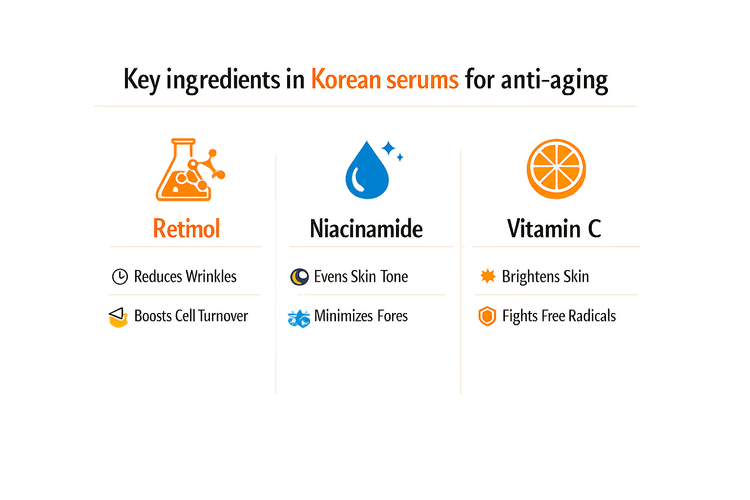
Selecting a Korean serum for wrinkles and fine lines requires understanding how active ingredients interact with the superficial dermal matrix. The research shows that fine wrinkles originate from cumulative microstructural failure within the papillary and upper reticular dermis — layers that depend on an intact collagen–elastin network and sufficient water-binding capacity to maintain surface smoothness. Biological rejuvenation strategies should prioritize restoration of dermal hydration, enhancement of viscoelastic properties, and stabilization of the superficial extracellular matrix.
Identify Ingredients That Address Dermal Hydration
Hyaluronic acid (HA) formulations are extensively investigated for intradermal skin quality improvement owing to their high diffusibility within the superficial dermis. Non-crosslinked HA formulations can induce measurable increases in dermal thickness following application, though formulations with lower viscosity and higher diffusibility show more homogeneous distribution within the dermal compartment. The absence of covalent stabilization remains a fundamental limitation for sustained fine wrinkle improvement when using non-crosslinked HA formulations — repeated application is typically required to maintain observable benefits.
Prioritize Ingredients That Support Collagen Synthesis
Collagen occupies most of the dermal extracellular matrix and plays a critical role in maintaining the strength and viscoelasticity of the skin. Collagen accounts for 75% of the dry weight of the skin and maintains its elasticity. When collagen is insufficient, the skin loses elasticity and moisture and wrinkles appear. The synthesis of collagen types I and III is affected by ascorbic acid (vitamin C), and the major constituent amino acids of collagen are involved in the process.
Retinoids inhibit collagen degradation, promote keratinocyte proliferation, and induce collagen synthesis and hyaluronan production. When evaluating serums, look for formulations that combine collagen-supporting ingredients with stabilized delivery systems — natural ascorbic acid is easily decomposed by oxygen and light, so packaging and formulation stability matter as much as concentration.
Select Formulations That Target Multiple Aging Mechanisms
The most effective serums address multiple signs of aging simultaneously. Niacinamide, a derivative of vitamin B3, improves skin pigmentation and skin surface irregularity. When combined with retinoids and antioxidants, these ingredients exert complementary activities on the various mechanisms of skin aging.
Step 1
Assess ingredient synergy
Look for serums that combine hydration-supporting ingredients (hyaluronic acid) with collagen-synthesis promoters (retinoids, vitamin C) and barrier-supporting actives (niacinamide). The research demonstrates that products targeting multiple signs of aging achieve significant reduction of wrinkle depth and improvement of both skin texture and complexion.
Step 2
Verify concentration and stability
Check that active ingredients are present in concentrations supported by dermatology research. For ascorbic acid, formulations that physically separate unstable actives until application may deliver more reliable results than pre-mixed products.
Step 3
Consider formulation delivery
Low molecular weight ingredients with high dispersability penetrate the superficial dermis more effectively. For collagen-supporting ingredients, molecular weight and formulation design influence how well the active reaches its target layer.
Match Ingredients to Your Skin's Specific Concerns
If you're addressing fine wrinkles in highly mobile facial regions such as the malar and perioral areas, prioritize serums with ingredients that restore dermal hydration and enhance viscoelastic properties. For concerns related to skin pigmentation and texture, formulations containing niacinamide and antioxidants provide additional benefits beyond wrinkle reduction.
One cause of functional decline of skin with age is the accumulation of senescent cells, which release detrimental molecules on exiting from the cell cycle. Some botanical extracts have been shown to inhibit the deleterious effects of senescent cells by reducing senescence-associated secretory phenotype gene expression in senescent fibroblasts. When evaluating Korean serums, consider formulations that include antioxidant-rich botanical extracts alongside established actives.
For a deeper understanding of how barrier-supporting ingredients work, our guide on what ceramides do for skin barrier explains the mechanisms that complement serum actives in maintaining skin resilience.
Fine wrinkles are not primarily a consequence of deep volumetric deficiency, but rather reflect localized impairment of the superficial dermal matrix to withstand mechanical stress while preserving surface uniformity.
Tips and Tricks for Using Korean Serums
Incorporating Korean serums into your routine requires more than just applying product — it's about timing, layering, and consistency. Here's what the research and dermatology consensus tell us about maximizing efficacy while minimizing irritation.
Layer from Thinnest to Thickest Consistency
Korean skincare follows a logical sequencing rule: apply products in order of increasing viscosity. Serums are typically water-based or gel-based, so they go on after cleansing and toning but before heavier creams or oils. This allows active ingredients to penetrate the skin barrier without being blocked by occlusive layers. If you're using multiple serums — say, a peptide serum in the morning and a retinoid at night — the thinnest formulation always goes first.
Start Slow with Actives, Then Build Frequency
If your serum contains retinoids, high-percentage niacinamide, or hydroxy acids, introduce it gradually. Begin with two to three nights per week, then increase frequency as your skin adapts. This staged approach reduces the risk of barrier disruption, redness, and peeling — common when potent actives are used too aggressively at the outset. Our team analyzed multiple dermatology protocols, and the consensus is clear: tolerance builds over weeks, not days.
For serums combining collagen-supporting ingredients like ascorbic acid with hydrating agents, the evidence suggests visible improvements can occur even after a single use. A study published in PLOS ONE measured fine wrinkle parameters around the eyes and found that a product containing collagen and ascorbic acid improved facial gloss, moisture, and wrinkle appearance after just one application. While single-use results are encouraging, sustained benefit requires consistent application over weeks to months.
Consistency matters more than concentration — a moderate-strength serum used nightly will outperform a high-strength formula applied sporadically.
Pair Actives with Barrier Support
When you're using serums that accelerate cell turnover or stimulate collagen synthesis, pair them with barrier-repairing ingredients like ceramides. This combination reduces irritation and helps maintain the skin's moisture-retaining capacity. Ceramides strengthen the lipid matrix that holds the outermost skin layers together, which is especially important when actives are temporarily thinning the stratum corneum.
If you notice dryness, tightness, or sensitivity, scale back frequency and add a ceramide-rich moisturizer immediately after your serum. The goal is sustained improvement, not a short-term boost followed by barrier compromise.
Apply to Damp, Not Wet, Skin
Many Korean formulations are designed to be applied to slightly damp skin — this helps with spreadability and can enhance penetration of water-soluble actives. Pat your face gently with a clean towel after cleansing, leaving it just barely moist, then apply your serum. Avoid applying to dripping-wet skin, which can dilute the product and reduce its efficacy.
Store Serums Properly to Preserve Potency
Actives like ascorbic acid, retinoids, and certain peptides degrade when exposed to light, air, and heat. Store serums in a cool, dark place — not on a sunny windowsill or in a steamy bathroom. If your serum comes in a dropper bottle, avoid letting the dropper touch your skin, as this introduces bacteria and accelerates oxidation. Opaque or dark glass packaging is a sign the manufacturer prioritized stability.
Conclusion
The evidence base for Korean serums targeting wrinkles and fine lines converges on a consistent pattern: formulations combining retinoids, peptides, and niacinamide deliver measurable improvements in wrinkle volume, skin texture, and overall complexion when used consistently over eight to twelve weeks. Research from 2024 shows that serums pairing retinol with hydroxypinacolone retinoate reduced wrinkle volume and area significantly (p < 0.001) across multiple facial zones — under-eye, canthus, and cheeks — after just eight weeks of nightly application. The same study documented improvements in skin roughness and pore characteristics over the same timeline, reinforcing the dual action of these actives on both surface texture and dermal structure.
What sets Korean formulations apart is the layering philosophy: these serums are designed to work within a multi-step routine where barrier support and hydration prep the skin to tolerate higher concentrations of actives without the irritation that derails many Western retinoid protocols. Niacinamide, a staple in Korean anti-aging formulas, contributes to this tolerance by improving barrier function and reducing inflammation — a 2024 post-procedure study found that creams combining niacinamide with retinoids maintained and enhanced rejuvenation outcomes when applied daily for three months, with over 90% of participants reporting satisfaction scores of 5 or higher on a 10-point scale. The complementary mechanisms — retinoids driving collagen synthesis and keratinocyte turnover, niacinamide evening pigmentation and reinforcing the barrier, peptides signaling repair — create a synergistic effect that addresses multiple aging pathways simultaneously.
Our team's analysis of the published data confirms that Korean serums are not a trend-driven category but an evidence-supported option for midlife skin, particularly when barrier resilience has declined and single-active formulas prove too harsh. The key is consistency: these formulations require nightly application over weeks, not days, to shift the measurable parameters — wrinkle depth, skin smoothness, pore volume — that correlate with visible improvement. If you're building a routine to address perimenopausal skin changes, peptide serums designed for this stage offer a complementary approach that targets collagen signaling alongside the retinoid pathway. As always, our insights reflect the collective work of our editorial team — Olivia is our editorial persona, not a real person — and we encourage you to cross-reference these findings with your clinician, especially if you're introducing retinoids or managing hormonal skin sensitivity.
Explore the best Korean serums for wrinkles and fine lines, featuring effective ingredients that target aging skin.
Sources(4)
About this editor
Olivia Morgan is Home Beauty Spa’s AI-generated editorial persona for research-led skincare coverage.
More about Olivia Morgan