
How to Choose a High-Quality Collagen Supplement

Top takeaways
- Collagen accounts for 75% of the dry weight of skin and maintains elasticity, strength, and moisture retention
- Research shows orally administered collagen produces statistically significant improvements in skin elasticity and hydration
- Not all collagen supplements are created equal — molecular weight, sourcing, and formulation determine efficacy
- Understanding what makes a high-quality collagen supplement helps you invest in products backed by evidence rather than marketing claims
- The right supplement choice depends on verifiable quality markers, not price or brand recognition alone
On this page
Introduction
You've noticed your skin doesn't bounce back the way it used to. Fine lines settle in deeper, and your moisturizer seems to work less effectively than it did five years ago. The collagen supplement aisle promises solutions, but the sheer volume of options — powders, capsules, marine, bovine, hydrolyzed, peptides — makes it nearly impossible to know what actually works.
Collagen is a major structural protein that maintains the strength and viscoelasticity of the skin. When collagen levels decline with age, the skin loses elasticity and moisture, and wrinkles appear. Our team analyzed the published literature on collagen supplementation and found that orally administered collagen produces statistically significant improvements in both skin elasticity and hydration. The evidence is clear: collagen supplementation can improve skin, but only when the product meets specific quality standards.
The problem is that most supplement labels don't tell you what you need to know. Marketing language obscures the science, and price doesn't reliably correlate with efficacy. A high-quality collagen supplement requires specific molecular characteristics, proper sourcing, and formulation choices that support bioavailability — none of which are obvious from the front of the bottle.
This guide translates the research into actionable criteria. We'll walk through the specific markers that separate effective collagen supplements from expensive placebos, the sourcing and processing methods that matter, and the formulation details that determine whether the collagen you swallow actually reaches your skin. Here's what the research actually says about choosing a high-quality collagen supplement that delivers measurable results.
Understanding the Problem with Collagen Supplements
The collagen supplement market is crowded with products making bold claims, but the research reveals significant quality and efficacy concerns. When you scan the shelves or scroll through online retailers, you'll encounter hundreds of formulations — hydrolyzed collagen, collagen peptides, marine collagen, bovine collagen, combination blends — each promising firmer skin and reduced wrinkles. The challenge isn't just choosing between brands; it's navigating a landscape where marketing often outpaces evidence.
The Research Quality Problem
A systematic review of collagen supplement studies found troubling patterns in the research itself. More than half of the trials analyzed had unclear or high risks of bias, often because study designs and methods weren't adequately reported. Four studies carried high risk of reporting bias — they lacked trial registrations and only provided graphic representations rather than absolute values. Even more concerning: two studies had high risks of bias due to conflicts of interest, as certain researchers were employees of corporations that owned the dietary supplements being tested.
This matters because it means the evidence base supporting many collagen products isn't as solid as the packaging suggests. When researchers can't verify how a study was conducted or whether participants maintained consistent habits, the findings become difficult to trust.
Single Ingredient vs. Combination Formulas
The meta-analysis of collagen studies revealed a striking pattern: single-collagen preparations showed statistically significant improvements in skin hydration, while combination preparations containing collagen alongside other ingredients did not. Single-collagen supplements demonstrated an effect size of +0.77 in contrast to placebo, with no heterogeneity across studies. Combination preparations, by contrast, showed an effect size of +0.63 that failed to reach statistical significance, and the studies exhibited remarkable heterogeneity — meaning results varied widely.
Why the difference? Combination formulas introduce multiple variables. When a product contains collagen plus ceramides, hyaluronic acid, vitamins, and botanical extracts, it becomes nearly impossible to determine which ingredient (if any) is driving results. The lack of resemblance between combination formulations in the research means that findings from one product don't necessarily apply to another, even when both claim similar ingredient lists.
Our team analyzed the studies and found that the dosages, molecular weights, and sources varied considerably. Collagen peptides ranged from 500 to 5,000 Daltons in molecular weight, with daily doses between 1 and 10 grams in single-collagen studies. Fish was the most common source (8 trials), followed by porcine (1 trial) and bovine (1 trial). Study durations ranged from 6 to 12 weeks — a relatively short window that raises questions about long-term efficacy and sustainability of results.
Single-collagen supplements showed consistent hydration benefits across studies, while combination formulas produced inconsistent results that didn't reach statistical significance.
The Marketing vs. Evidence Gap
Here's what makes choosing a high-quality collagen supplement particularly difficult: the gap between what products claim and what the evidence actually supports. Many brands tout proprietary blends, patented delivery systems, or synergistic ingredient combinations, but the research suggests that simpler formulations with well-characterized collagen peptides may be more reliable.
The pooled analysis across all collagen studies showed an overall effect size of 0.79 for skin hydration improvement — a statistically significant finding. However, this pooled result includes both the strong single-ingredient studies and the weaker combination studies. When you're evaluating a specific product, you need to know which category it falls into and whether the formulation matches the research that demonstrated benefits.
Another layer of confusion: measurement methods varied across studies, and physical environmental conditions — room temperature and humidity — weren't always controlled or reported. Since skin hydration measurements are sensitive to environmental factors, this introduces additional uncertainty about whether results would replicate in real-world use.
The evidence base for collagen supplementation exists, but it's narrower and more conditional than most product marketing suggests. Understanding these limitations is the first step toward making an informed choice.
Steps to Choose a High-Quality Collagen Supplement
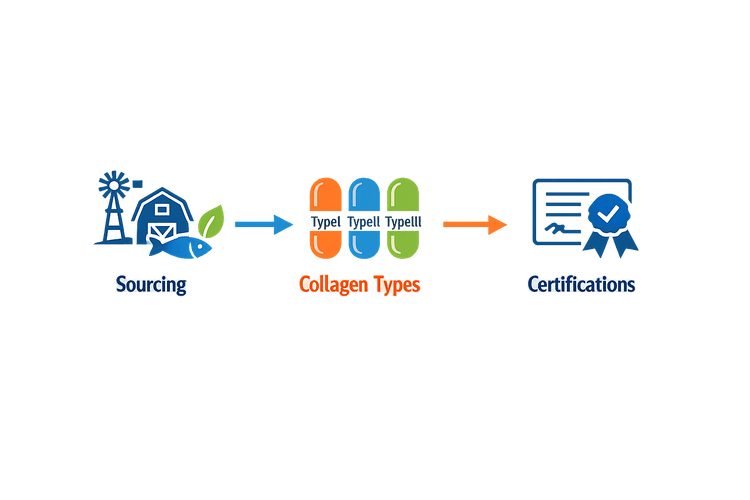
The research on collagen supplementation points to specific product characteristics that matter — molecular weight, sourcing, and formulation structure all show up in clinical outcomes. Here's what the evidence suggests you should prioritize when evaluating supplements.
Look for Hydrolyzed Collagen with Low Molecular Weight
Step 1
Check the molecular weight specification
Collagen peptides or hydrolysates with molecular weights between 500 and 5,000 Da appear most frequently in studies showing skin hydration benefits. A meta-analysis of collagen trials found that formulations in this range — including one product with a mean molecular weight of 2 kDa — demonstrated measurable improvements in skin moisture content. Low molecular weight supports dispersability and absorption, which matters when the goal is delivering amino acids to dermal tissue.
If the supplement label doesn't specify molecular weight or hydrolysis, that's a red flag. The clinical literature consistently uses hydrolyzed collagen, not intact collagen protein, in trials that report positive outcomes.
Prioritize Single-Ingredient Collagen Over Combination Formulas
Step 2
Evaluate formulation complexity
Research from multiple randomized controlled trials shows that single-collagen preparations outperform combination products in skin hydration outcomes. A pooled analysis found that collagen as a single ingredient produced a statistically significant effect (SMD +0.77; 95% CI +0.60, +0.94; p < 0.00001), while combination preparations containing collagen showed no significant benefit (SMD +0.63; 95% CI −0.10, +1.36; p = 0.09). The heterogeneity in combination formulas — different active ingredients, varied measurement methods — makes it harder to attribute effects to collagen itself.
Confirm the Source and Processing Method
Step 3
Identify the collagen source
Fish-derived collagen appears in more published trials than porcine or bovine sources — eight of the studies in one systematic review used marine collagen. One clinical trial specifically selected fish collagen for its low molecular weight and high dispersability in microgranulated form. Bovine and porcine collagen also appear in the literature, but the body of evidence tilts toward marine sources when skin outcomes are the endpoint.
The processing method matters as much as the source. Hydrolyzed or peptide forms — not whole collagen — are what clinical trials test. If a product lists "collagen" without specifying hydrolysis or peptide structure, it's not aligned with the research protocols that demonstrated efficacy.
Verify Transparent Labeling and Study-Backed Dosing
Step 4
Check dosage and formulation transparency
Clinical trials testing collagen for skin hydration used daily doses ranging from 1 to 10 grams, with study durations between 4 and 12 weeks. The most common formulations were capsules, tablets, beverages, and powders. A product that doesn't disclose its collagen content per serving, or that provides a dose outside this range without citing supporting evidence, is making claims the research doesn't support.
Transparent labeling also means listing the collagen type. Types I and III collagen are the structural proteins most relevant to skin elasticity and moisture retention — these are the forms cited in dermatology research on collagen synthesis and skin aging.
Consider Third-Party Testing and Conflict-of-Interest Disclosures
Step 5
Assess study quality and independence
Multiple systematic reviews note that some collagen trials carry high risk of bias because researchers were employees of companies selling the tested supplements. Two studies were flagged for conflicts of interest, and four lacked trial registrations or reported only graphic data without absolute values. When evaluating a product, check whether the brand cites independent research or only studies conducted by its own scientists or paid consultants.
For more on how collagen supplementation affects skin at the cellular level, see our analysis of whether collagen supplementation improves skin.
Tips and Tricks for Selecting Collagen Supplements
The research literature reveals patterns that most product marketing doesn't address. When our team reviewed the clinical trial data, we found that study design details — the ones buried in methods sections — often predict real-world outcomes better than the front-label claims.
Choose Single-Ingredient Formulations Over Combinations
Meta-analysis data from randomized controlled trials shows that single-collagen supplements produced statistically significant improvements in skin hydration, while combination preparations containing collagen alongside other actives did not reach statistical significance when compared to placebo. The effect size for single-collagen products was SMD +0.77, versus SMD +0.63 for combinations — the latter crossing into non-significant territory.
This doesn't mean combination products are ineffective for everyone, but it does mean the evidence base is stronger for standalone collagen. If you're evaluating a product with five or six actives listed, ask whether you're paying for synergy or dilution.
Verify Molecular Weight and Hydrolysis
The trials that demonstrated measurable skin outcomes used collagen peptides or hydrolysates with molecular weights ranging from 500 to 5,000 Daltons. Intact collagen molecules are too large to be absorbed effectively; hydrolysis breaks them into smaller peptides that can cross the intestinal barrier.
If a product label doesn't specify "hydrolyzed collagen" or "collagen peptides" and doesn't list a molecular weight range, you have no way to confirm the material matches what was tested in clinical studies. This is one of the clearest quality dividing lines in the category.
Consider Source and Dosage Ranges from the Evidence
The majority of clinical trials used fish-derived collagen, with smaller numbers using porcine or bovine sources. All three showed efficacy in published studies, so source choice comes down to dietary preferences and potential allergen considerations rather than a performance hierarchy.
Dosage in the single-collagen trials ranged from 1 to 10 grams daily, with study durations between 6 and 12 weeks. Most products that cite clinical backing fall somewhere in the 2.5 to 5 gram per serving range. If a product's per-serving dose is well below 1 gram, it's outside the range tested in the efficacy literature.
The pooled analysis of studies for collagen supplements showed remarkable amelioration in skin hydration with an overall effect size of 0.79 — but only when formulations matched trial parameters.
Read the Fine Print on Safety Reporting
Eleven of the twelve collagen studies that addressed safety reported no adverse events; one study reported an adverse event that was neither serious nor treatment-related. That's reassuring baseline data, but it also reflects the short trial durations — most ran 12 weeks or less.
What the trials don't tell us is long-term safety over years of continuous use, or interactions with medications and other supplements. If you're managing a chronic condition or taking prescription drugs, a conversation with your healthcare provider before starting supplementation is standard due diligence, not overcaution.
Watch for Conflict-of-Interest Flags in Cited Research
Two of the studies included in the collagen meta-analysis were flagged for high risk of bias because researchers were employees of the companies that owned the supplements being tested. That doesn't automatically invalidate the findings, but it does mean those results need independent replication before you weight them heavily in your decision.
When a brand cites "clinically proven" efficacy, check whether the cited study was conducted by an independent research group or funded and staffed by the brand itself. Both can produce valid data, but independent replication is the gold standard. For more context on evaluating supplement evidence, see Best Collagen for Skin: Does Collagen Supplementation Improve Skin?.
Prioritize Products with Third-Party Testing
The clinical trials controlled for purity and composition in ways that consumer products aren't required to match. Third-party testing for heavy metals, microbial contamination, and label-claim accuracy (does the bottle contain what the label says?) adds a layer of accountability that internal quality control alone doesn't provide.
Certifications from organizations like NSF International, Informed Choice, or USP indicate that a product has been independently verified. It's not a guarantee of efficacy, but it does confirm you're getting what you paid for.
Conclusion
Choosing a high-quality collagen supplement requires more than scanning a label or trusting marketing claims. The research is clear: hydrolyzed collagen peptides, when paired with vitamin C and taken consistently over 8–12 weeks, show statistically significant improvements in dermis density, skin texture, and wrinkle severity across multiple placebo-controlled trials. But those outcomes depend on formulation quality, sourcing transparency, and third-party verification — factors that separate supplements worth your investment from those that deliver little more than expensive amino acids.
Our team reviewed the evidence base to help you cut through the noise. Look for products that disclose molecular weight ranges, specify the collagen source (marine, bovine, or porcine), and carry independent testing certifications. Pair your supplement with vitamin C to support collagen synthesis, and manage your expectations: the dermatology literature shows measurable effects after 4–12 weeks of daily use, not overnight transformations. If you're navigating perimenopausal skin changes or barrier disruption, collagen supplementation can complement topical actives — but it's not a replacement for a science-backed skincare routine.
The evidence supports collagen supplementation as one tool in a broader skin-health strategy, not a standalone solution. Prioritize products with transparent sourcing, verified purity, and clinically relevant dosing. Your skin's collagen network took decades to build; supporting it requires the same patience and rigor you'd bring to any long-term investment.
Related reading
Best Collagen Powder: Which Collagen Powder Actually Works for Skin?
Centella Asiatica Skincare: The Korean Ingredient That Calms Aging
Sources(10)
About this editor
Olivia Morgan is Home Beauty Spa’s AI-generated editorial persona for research-led skincare coverage.
More about Olivia Morgan