
Skin Changes Perimenopause: Why Your Skincare Stopped Working


Top takeaways
- Perimenopause triggers measurable changes in skin barrier function, collagen density, and sebum production that make previously effective products feel inadequate.
- Estrogen decline during this transition directly affects skin structure, moisture retention, and repair capacity — not just surface symptoms.
- Adapting your routine to support barrier integrity, hydration, and cellular turnover can address the root causes of midlife skin changes rather than chasing temporary fixes.
- Evidence-based ingredient choices — retinoids, ceramides, antioxidants — offer targeted support when formulated and layered correctly for hormonally shifting skin.
Introduction
You've been using the same moisturizer for years. It worked beautifully through your thirties, kept your skin balanced and comfortable, and required no second-guessing. Then, somewhere in your early forties, it stopped working. Your skin feels tight by midday, fine lines that weren't there last year have settled in, and products that once absorbed seamlessly now sit on the surface or trigger sensitivity.
This isn't product failure — it's skin changes perimenopause brings, and the shift is both structural and biochemical. Our team has analyzed the dermatology literature on perimenopausal skin, and the mechanism is well-documented: declining estrogen levels alter collagen synthesis, lipid production, and barrier integrity in ways that fundamentally change what your skin needs.
The clinical evidence shows that estrogen receptors are abundant in skin tissue, and as hormone levels fluctuate and decline during perimenopause, skin becomes measurably thinner, drier, and less resilient. A 2020 review in the Journal of Integrative Dermatology outlines how these changes affect everything from transepidermal water loss to inflammatory response, creating a cascade of visible and tactile differences that no amount of the same old routine can address.
This guide walks through what actually happens to skin during perimenopause, why your current products may no longer match your skin's needs, and how to adapt your routine with evidence-based ingredients and practices. We'll cover the physiology, the common mistakes, and the therapeutic options — including topical retinoids, antioxidants, and barrier-repair agents — that dermatology research supports for this life stage.
Explore how perimenopause affects your skincare routine and discover effective solutions for midlife skin changes.
What is Perimenopause?
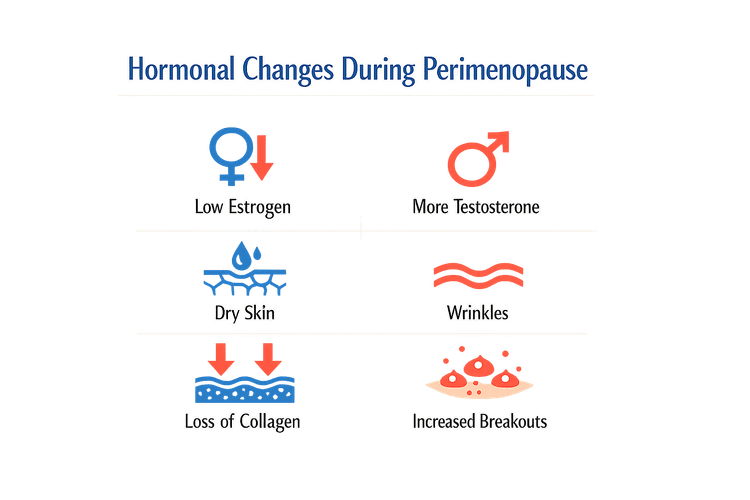
Perimenopause is the transitional phase before menopause when your ovaries gradually produce less estrogen. This phase typically begins in your forties, though some women enter it earlier or later. The hallmark of perimenopause is hormonal fluctuation — estrogen and progesterone levels don't simply decline steadily; they swing unpredictably, creating a cascade of physical changes that extend well beyond the reproductive system.
The transition lasts an average of four years, though the range spans from a few months to over a decade. You're officially in perimenopause when menstrual cycles become irregular — shorter, longer, heavier, lighter, or skipped entirely. Menopause is declared after twelve consecutive months without a period, marking the end of perimenopause and the beginning of postmenopause.
The Hormonal Cascade
Estrogen decline drives most of the skin changes you'll notice during this phase. Estrogen receptors exist throughout the skin, particularly in the dermis where collagen and elastin reside. When estrogen levels drop, these receptors receive fewer signals to maintain collagen production, preserve skin thickness, and regulate sebum output.
Progesterone also declines during perimenopause, though its skin effects are less direct. Progesterone influences oil production and can affect skin sensitivity. The erratic fluctuations of both hormones — not just their eventual decline — create the unpredictable skin behavior many women experience during this transition.
Why Timing Varies
Genetics largely determine when perimenopause begins. If your mother entered perimenopause early, you're more likely to follow a similar timeline. Smoking accelerates the transition by one to two years on average. Certain medical treatments — chemotherapy, oophorectomy, or pelvic radiation — can trigger surgical or medical menopause, bypassing the gradual perimenopausal phase entirely.
The unpredictability of perimenopause makes skincare adaptation challenging. Your skin may behave one way for months, then shift abruptly as hormone levels swing. What worked last season may fail this season, not because the products changed, but because your skin's hormonal environment did. Understanding the barrier changes that accompany hormonal shifts helps you anticipate and address these fluctuations rather than chase them reactively.
Why Perimenopause Matters for Skincare
Your moisturizer didn't stop working because the formula changed. It stopped working because your skin did. Declining estrogen levels during perimenopause trigger structural, functional, and aesthetic changes in the skin — and those changes directly undermine the products and routines that worked reliably for years.
Estrogen deficiency contributes to collagen loss, impaired barrier integrity, reduced elasticity, and increased transepidermal water loss — a measurable acceleration of water evaporating through the skin's surface. These shifts exacerbate xerosis (clinical dryness) and skin sensitivity, making previously tolerable actives feel harsh and previously adequate hydration feel insufficient.
Hormonal Decline Reshapes Skin Function
Research shows that declining estrogen and shifts in other sex hormones trigger a spectrum of cutaneous and hair changes, including dryness, pruritus (itching), impaired barrier function, acne, rosacea, hair thinning, increased facial hair, and accelerated skin aging. These aren't cosmetic inconveniences — they're physiological changes with documented mechanisms.
The skin's barrier — the outermost layer that regulates water retention and blocks irritants — becomes measurably weaker as estrogen declines. Collagen synthesis slows. Sebum production drops. The skin's natural moisturizing factor diminishes. What you're experiencing isn't a product failure; it's a hormonal recalibration that your existing routine wasn't designed to address.
Why Your Routine Feels Inadequate Now
A routine built for your thirties assumed stable hormone levels, consistent sebum production, and reliable barrier function. Perimenopause disrupts all three. The lightweight moisturizer that felt perfect at 35 may now leave your skin tight by midday. The exfoliating acid that gave you glow may now trigger redness. The cleanser that felt refreshing may now strip your skin.
These aren't product problems — they're mismatch problems. The products haven't changed; your skin's needs have. Adapting your routine to perimenopause means acknowledging that hormonal skin changes require hormonal-era solutions: richer barrier repair, gentler exfoliation, and active ingredients that support collagen and hydration rather than simply removing oil or dead cells.
Common Skin Changes During Perimenopause
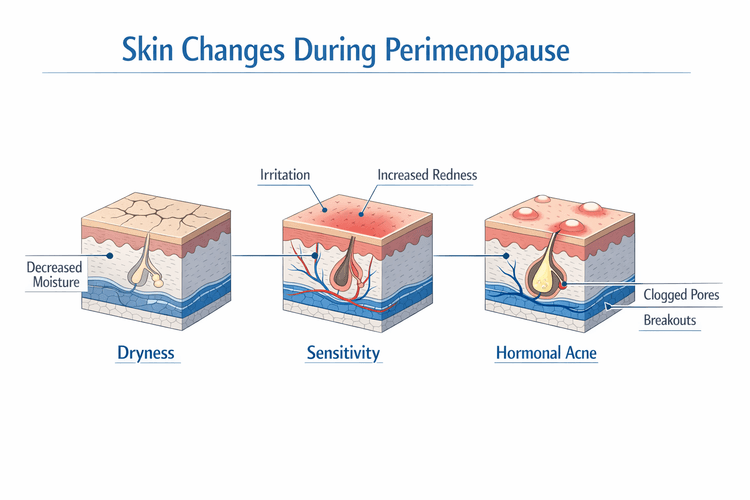
You've noticed your skin behaving differently — drier patches where you never had them, sudden sensitivity to products you've used for years, or uneven tone that wasn't there six months ago. These aren't random occurrences. Research from the National Institutes of Health shows that declining ovarian hormones during perimenopause trigger measurable structural changes in the skin, including compromised thickness and barrier function.
The changes aren't subtle, and they don't wait for menopause to begin. Our team analyzed the dermatology literature and found that skin alterations start years before your final period, often catching women off guard when their established routines suddenly stop delivering results.
Dryness and Barrier Compromise
Estrogen decline directly impacts the skin's ability to retain moisture. According to the American Academy of Dermatology, as hormone levels drop during perimenopause, skin becomes noticeably drier and thinner. This isn't just surface dehydration — it's structural.
The lipid matrix that holds your barrier together weakens when estrogen falls. You'll notice tightness after cleansing that lingers longer than it used to, or flaking in areas that were previously resilient. Products that felt hydrating now seem to sit on the surface without penetrating.
Transepidermal water loss accelerates during this transition. The skin loses its ability to hold onto moisture efficiently, creating a cycle where dryness begets more dryness. If you're struggling with persistent dryness despite layering hydrators, understanding transepidermal water loss can help you target the root cause rather than just treating symptoms.
Sensitivity and Reactivity
Skin that tolerated active ingredients without issue may suddenly react with redness, stinging, or breakouts. This isn't your imagination — hormonal fluctuations during perimenopause genuinely alter your skin's tolerance threshold.
The same retinoid concentration you've used for years might now trigger irritation. Acids that once delivered smooth texture may leave you inflamed. Even fragrance in products you've repurchased for a decade can suddenly become problematic.
This heightened reactivity stems from barrier thinning and inflammatory changes tied to hormone shifts. Your skin isn't "turning against you" — it's responding to a genuinely altered physiological state that requires adjusted product strategies.
Uneven Pigmentation and Tone
Melanocyte numbers decrease during perimenopause, but they don't decrease uniformly. The result is heterogeneous pigmentation — areas of hyperpigmentation alongside areas where pigment fades, creating an uneven, mottled appearance that makeup can't fully correct.
You might notice new dark spots appearing, especially on the cheeks and forehead, while other areas look washed out. This isn't melasma in the traditional sense, though hormonal fluctuations can trigger or worsen existing melasma. It's a broader disruption of pigment distribution across the face.
Sun damage from decades past often surfaces during this period as well. Spots that were invisible when estrogen kept skin turning over efficiently now become visible as cell renewal slows. What looks like "sudden" pigmentation is often cumulative damage finally becoming apparent.
Texture Changes and Loss of Firmness
Skin slackness becomes noticeable during perimenopause as collagen production declines and existing collagen degrades faster than it's replaced. The skin doesn't bounce back the way it used to after sleep or dehydration. Fine lines deepen, and the overall surface feels less taut.
Pore appearance often worsens during this transition. It's not that pores are getting larger — it's that loss of surrounding structural support makes them more visible. The same pore that was barely noticeable in your thirties becomes prominent in your mid-forties as the tissue around it loses density.
Texture roughness increases as cell turnover slows. Dead cells accumulate on the surface longer, creating a dull, uneven feel that no amount of exfoliation seems to fully resolve. This is a metabolic shift, not a cleansing issue.
Acne and Breakouts
Perimenopausal acne catches many women off guard, especially those who never struggled with breakouts in adolescence. The mechanism is different from teenage acne — it's driven by the changing ratio of estrogen to androgens, not by absolute androgen levels.
Breakouts tend to cluster along the jawline and chin, appearing cyclically as hormone levels fluctuate throughout the menstrual cycle. They're often deeper, more inflamed, and slower to heal than the acne you might have experienced in your twenties.
Perimenopausal acne is hormonally driven, but it presents on skin that's simultaneously drier and more sensitive — a combination that makes traditional acne treatments poorly tolerated.
The skin is also less resilient to the irritation that acne treatments typically cause. Benzoyl peroxide and salicylic acid, mainstays of acne care, often trigger excessive dryness and sensitivity on perimenopausal skin, requiring gentler formulations and strategic application.
How to Adapt Your Skincare Routine for Perimenopause
Your moisturizer worked for a decade, then stopped. Your cleanser suddenly feels stripping. The retinol you tolerated fine now irritates for days. These aren't product failures — they're signals that your skin's needs shifted faster than your routine did. Here's how to recalibrate.
Start with gentler cleansing
Declining estrogen reduces sebum production and thins the barrier, making traditional foaming cleansers too harsh for many perimenopausal women. The American Academy of Dermatology recommends switching to a mild cleanser instead of soap-based formulas, which can strip the compromised barrier further and accelerate transepidermal water loss.
Look for cream or gel cleansers with a near-neutral pH. If your face feels tight after washing, your cleanser is too aggressive for your current barrier state. The goal is clean skin, not squeaky-clean skin — that squeaky feeling is your lipid barrier being stripped away.
Layer hydration strategically
Perimenopausal skin loses water faster than it did in your thirties. The fix isn't just more moisturizer — it's smarter hydration layering. The American Academy of Dermatology advises using moisturizers containing humectants like hyaluronic acid or glycerin, which pull water into the skin, followed by occlusives that seal it in.
Apply hydrating products to damp skin immediately after cleansing. A hyaluronic acid serum on wet skin, followed by a ceramide-rich moisturizer, creates a hydration sandwich that addresses both water loss and barrier repair. If you wake up with dry patches despite moisturizing at night, add an occlusive final layer — a thin application of a barrier cream or facial oil locks everything underneath in place. For a deeper look at barrier-repair ingredients, see our guide to ceramides.
Protect daily, without exception
Estrogen loss makes skin more vulnerable to UV damage, and perimenopausal skin shows photoaging faster than it did pre-hormonally. The American Academy of Dermatology is unambiguous: apply a broad-spectrum sunscreen with SPF 30 or higher every day to prevent age spots and reduce skin cancer risk.
This isn't negotiable anymore. Thinning skin, reduced melanin regulation, and slower DNA repair mean UV exposure does more damage now than it did at 35. Mineral sunscreens with zinc oxide or titanium dioxide are often better tolerated by newly sensitive skin, though modern chemical filters in gentle formulations work well too. Reapply every two hours during extended sun exposure, and treat sunscreen as the non-negotiable anchor of your routine.
Step 1
Morning: cleanse, hydrate, protect
Gentle cleanser on damp skin, hyaluronic acid serum while still wet, ceramide moisturizer, then broad-spectrum SPF 30+ as the final step. This sequence addresses barrier support and UV protection in under three minutes.
Step 2
Evening: repair and restore
Mild cleanser, hydrating toner or essence, treatment active if tolerated (retinoid, niacinamide, peptide serum), then a richer moisturizer or occlusive layer. The evening routine is where barrier repair happens.
Reintroduce actives slowly
If your retinoid suddenly irritates, don't abandon it — adjust the delivery. Perimenopausal skin often needs the same actives but can't tolerate the same concentrations or frequencies. Start with twice-weekly application, buffer with moisturizer, or switch to a gentler retinoid formulation.
Niacinamide, peptides, and antioxidants like vitamin C support collagen and barrier function without the irritation risk of high-strength retinoids. When your barrier is stable — no flaking, no stinging from products that didn't bother you before — you can cautiously increase active frequency. If sensitivity returns, pull back again. Your skin will tell you its tolerance threshold; listen to it.
Best Practices for Perimenopause Skincare
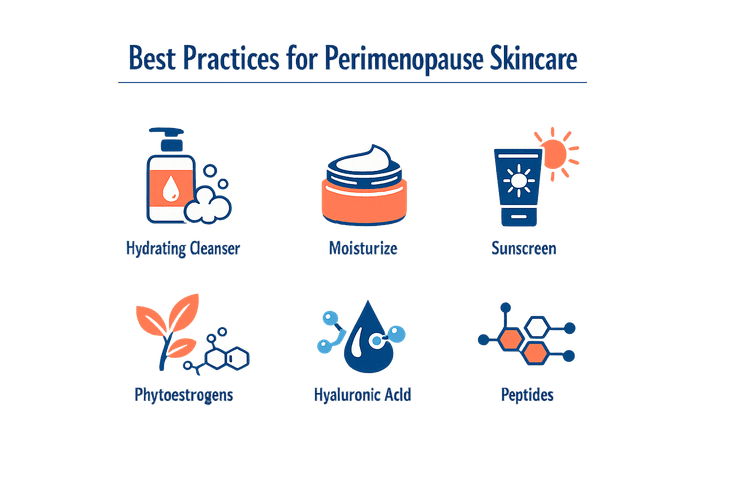
The foundation of effective perimenopause skincare rests on a few evidence-backed principles that address the specific vulnerabilities of estrogen-depleted skin. Our team analyzed dermatology guidance and found consistent recommendations across clinical sources: prioritize barrier repair, protect against photodamage, and introduce active ingredients gradually to avoid overwhelming sensitized skin.
Daily Sun Protection Is Non-Negotiable
According to the American Academy of Dermatology, applying a broad-spectrum sunscreen with SPF 30 or higher every day is essential during menopause to prevent age spots and reduce skin cancer risk. Estrogen loss makes skin more susceptible to UV damage, and hyperpigmentation becomes harder to reverse once established. Choose mineral formulas with zinc oxide or titanium dioxide if chemical filters irritate your skin, and reapply every two hours during extended sun exposure.
Gentle Cleansing and Strategic Moisturizing
The American Academy of Dermatology recommends washing with a mild cleanser instead of soap and applying a moisturizer with hyaluronic acid or glycerin for dry skin during menopause. Harsh surfactants strip the already-compromised barrier, accelerating transepidermal water loss. Look for creamy, low-pH cleansers that leave skin feeling soft rather than tight.
Moisturizer application matters as much as formulation. Apply to damp skin immediately after cleansing to trap water in the stratum corneum. If your skin feels dry within an hour, layer a second moisturizer or add a facial oil over your cream to seal in hydration. Ceramide-rich formulas are particularly effective for reinforcing the lipid matrix that estrogen decline disrupts.
Introduce Actives Slowly and Strategically
Perimenopausal skin often becomes more reactive, so the "more is more" approach to active ingredients backfires. Start retinoids at the lowest concentration and use them twice weekly for the first month, gradually increasing frequency as tolerance builds. Pair retinoids with niacinamide to mitigate irritation and support barrier function.
Step 1
Start low, go slow
Begin with one new active ingredient at a time. Wait four weeks to assess tolerance before adding another. This approach isolates any irritation to a single product rather than forcing you to eliminate your entire routine.
Step 2
Layer for tolerance
Apply actives over moisturizer (the "sandwich method") when first introducing them. This buffers penetration and reduces irritation without eliminating efficacy.
Step 3
Watch for barrier compromise
If you develop stinging, persistent redness, or flaking that doesn't resolve within a week, pull back on actives and focus exclusively on barrier repair for two weeks before reintroducing them.
Hydration Ingredients That Actually Work
Hyaluronic acid and glycerin are humectants that draw water into the skin, but they need occlusive ingredients to prevent that water from evaporating. The most effective moisturizers for perimenopausal skin combine humectants with occlusives like squalane, shea butter, or petrolatum. If you live in a dry climate, skip standalone hyaluronic acid serums unless you layer an occlusive cream over them within 60 seconds.
The best moisturizer is the one you'll use consistently — formulation matters less than compliance when barrier function is compromised.
Consistency Over Complexity
A simple, consistent routine outperforms an elaborate, sporadic one. Perimenopausal skin responds better to steady, gentle support than to aggressive intervention followed by recovery periods. Establish a baseline routine of cleanser, moisturizer, and sunscreen, then add one targeted active ingredient at a time based on your primary concern — retinoid for texture and firmness, azelaic acid for hyperpigmentation, or niacinamide for barrier support and redness.
Common Skincare Mistakes to Avoid During Perimenopause
You've invested in the right actives, updated your routine, and started addressing dryness and sensitivity — but if your skin still feels reactive or your products aren't delivering results, the issue may not be what you're using. It's often what you're overdoing, skipping, or misunderstanding about how perimenopausal skin behaves. As estrogen declines and the barrier thins, missteps that once caused minor irritation now trigger inflammation, dehydration, and visible damage that takes weeks to resolve.
Our team reviewed common pitfalls reported in clinical practice and dermatology literature. The mistakes below show up repeatedly in midlife skincare routines — and they're all reversible once you recognize the pattern.
Over-Exfoliating Thinning Skin
Perimenopausal skin is already thinning as estrogen drops. According to the American Academy of Dermatology, this thinning makes skin more prone to bruising and surface damage. Yet many people respond to dullness or texture changes by increasing exfoliation frequency or layering multiple acids — glycolic, salicylic, lactic — without adjusting for the barrier's reduced capacity.
If you're using a chemical exfoliant more than twice weekly, or if you're combining daily retinoid use with frequent acid treatments, scale back. The goal is cell turnover support, not aggressive resurfacing. When the barrier is compromised, less frequent exfoliation with gentler concentrations produces better long-term results than high-frequency protocols.
Skipping Sunscreen on Cloudy Days or Indoors
The American Academy of Dermatology notes that daily sunscreen use can help mitigate the visible effects of skin thinning during menopause. Yet sunscreen compliance drops when the weather turns gray or when you're working from home. UVA penetrates clouds and windows — it's the wavelength responsible for collagen degradation and pigment changes, and it doesn't take a day off because you do.
If you've been diligent about retinoids, peptides, and antioxidants but inconsistent with sun protection, you're undoing the repair work those actives provide. Perimenopausal skin has less collagen reserve and a slower repair cycle; unprotected UVA exposure accelerates both processes. Apply a broad-spectrum SPF 30 or higher every morning, regardless of your plans or the forecast.
Treating Dryness with Occlusives Alone
When skin feels dry, the instinct is to reach for a rich cream or oil. But if you're layering occlusives — petrolatum, dimethicone, heavy plant oils — over skin that lacks water and humectants, you're sealing in dryness rather than correcting it. Perimenopausal skin loses both water-holding capacity and lipid content; it needs hydration first, then barrier reinforcement.
A more effective approach: apply a hydrating serum or essence with humectants like hyaluronic acid or glycerin to damp skin, then follow with a ceramide-rich moisturizer that provides both lipids and occlusion. Occlusives work when there's moisture to trap; without that step, they just sit on the surface.
Using the Same Routine Year-Round
Your skin's needs shift with hormone fluctuations, and those fluctuations don't follow a predictable schedule during perimenopause. A routine that worked in July may leave your skin tight and flaky in January, or a product that felt soothing in winter may trigger breakouts in humid summer months. Yet many people lock into a single regimen and assume any problems are product failures rather than seasonal mismatches.
Check in with your skin every few months. If dryness increases, add a heavier moisturizer or a hydrating mask once weekly. If you're seeing more congestion, lighten your evening moisturizer or add a gentle exfoliant. Perimenopausal skin is dynamic — your routine should be too.
The products that worked in your thirties aren't wrong now; your skin's tolerance and repair speed have changed, and your routine needs to account for that shift.
Ignoring Product Interactions and Layering Order
As you add barrier-supportive actives — retinoids, niacinamide, peptides, antioxidants — the risk of product interference increases. Layering a low-pH vitamin C serum immediately before a retinoid can reduce the efficacy of both. Applying niacinamide and a strong acid in the same routine may cause flushing in sensitive skin. Combining multiple actives without attention to pH, timing, or penetration order leads to irritation and wasted product.
If you're using more than two actives in a single routine, separate them by time of day or alternate nights. Start with the thinnest, most water-based products and move toward thicker, oil-based layers. When in doubt, simplify — three well-chosen products used consistently outperform six products applied haphazardly.
Expecting Immediate Results from Barrier Repair
You've switched to gentler cleansers, added ceramides, cut back on exfoliation — and after two weeks, your skin still feels reactive. The mistake isn't the approach; it's the timeline expectation. Barrier repair in perimenopausal skin takes longer than it did in your twenties. The lipid synthesis rate has slowed, and the skin's inflammatory response is more persistent.
Most barrier-repair protocols require four to six weeks of consistent use before you see measurable improvement in hydration, sensitivity, or texture. If you're changing products every two weeks because you're not seeing results, you're restarting the repair cycle rather than completing it. Commit to a simplified routine for at least a month before evaluating whether it's working.
Frequently Asked Questions About Perimenopause Skincare
When should I start adjusting my skincare routine for perimenopause?
You don't need to wait for a diagnosis. If you've noticed your moisturizer stopped working, your skin feels thinner, or breakouts appeared in your forties, those are signals your barrier needs more support. Perimenopause typically begins in the mid-to-late forties, but hormonal fluctuations can start earlier. The research shows estrogen decline affects skin parameters measurably — hydration drops, barrier function weakens, and collagen synthesis slows.
Our team recommends watching for functional changes rather than calendar age. When your usual products no longer deliver the same results, that's the moment to reassess your routine and add barrier-supportive ingredients.
Can I use retinoids during perimenopause if my skin feels sensitive?
Yes, but the approach matters. Retinoids remain effective for collagen support and cell turnover during perimenopause, but a weakened barrier means you may not tolerate the same concentration or frequency you used in your thirties. Start with a lower percentage or a gentler retinoid formulation, apply it less frequently (two to three times per week initially), and always pair it with a barrier-repair moisturizer containing ceramides.
If irritation persists, consider alternating retinoid nights with a nourishing recovery routine. The goal is consistent use over time, not aggressive application that triggers inflammation and further barrier compromise.
Is hormone replacement therapy (HRT) necessary for skin health during perimenopause?
HRT is a medical decision that extends far beyond skincare. The Women's Health Initiative results led to a decline in HRT use, but recent re-evaluations suggest HRT may benefit skin health during perimenopause by supporting estrogen levels that enhance skin parameters and barrier function. However, HRT carries risks and benefits that vary by individual health profile, family history, and symptom severity.
Our team cannot provide prescribing guidance — that conversation belongs with your clinician. What we can say is that topical skincare adjustments (barrier repair, antioxidants, targeted actives) address many perimenopausal skin concerns effectively, regardless of whether you pursue systemic hormone therapy. For more on barrier-supportive ingredients, see our guide to ceramides.
Why does my skin look dull even when I exfoliate regularly?
Exfoliation removes surface cells, but dullness during perimenopause often stems from slower cell turnover, reduced lipid production, and compromised barrier hydration — not just dead-cell buildup. Over-exfoliating a weakened barrier can worsen the problem by triggering inflammation and increasing transepidermal water loss.
The evidence suggests a better approach: gentle exfoliation (once or twice weekly with a low-percentage hydroxy acid) combined with hydration-focused products and antioxidants like vitamin C to support radiance from within. If your skin feels tight or reactive after exfoliating, you're stripping the barrier faster than it can repair.
Can perimenopause cause adult acne, and how should I treat it?
Yes. Hormonal fluctuations during perimenopause — particularly the shifting estrogen-to-androgen ratio — can trigger breakouts even if you never had acne before. Adult hormonal acne typically appears along the jawline, chin, and lower cheeks, and it often coincides with increased skin sensitivity.
Treatment requires balancing acne management with barrier support. Salicylic acid (a beta-hydroxy acid) works well for clogged pores without the harshness of benzoyl peroxide on already-sensitive skin. Niacinamide helps regulate sebum and calm inflammation. Avoid the temptation to strip your skin with multiple drying treatments — that compromises the barrier further and can worsen both acne and sensitivity.
How long does it take to see results from a new perimenopause skincare routine?
Barrier repair and hydration improvements typically show within two to four weeks — your skin will feel less tight, flaking decreases, and products absorb better. Deeper changes like improved firmness, reduced pigmentation, and collagen support from retinoids or peptides require consistent use over eight to twelve weeks.
The research on skin turnover and repair timelines supports patience. If a product irritates your skin within the first week, that's a signal to adjust concentration or frequency. But if a well-tolerated routine hasn't shown any functional improvement after six weeks, reassess your ingredient choices or consult a dermatologist.
Do I need different products for day and night during perimenopause?
Not necessarily, but strategic layering helps. Daytime priorities include barrier protection, hydration, and broad-spectrum SPF (non-negotiable for preventing further collagen breakdown and pigmentation). Nighttime is when you introduce actives like retinoids, peptides, or higher-concentration niacinamide, because your skin repairs itself during sleep and you're not facing UV exposure.
Many people find a simpler routine works better during perimenopause than the multi-step regimens marketed for anti-aging. Focus on a few evidence-backed ingredients that address your specific concerns rather than layering ten products that may overwhelm a compromised barrier.
Conclusion
Your skincare stopped working because your skin changed — not because you were doing anything wrong. The research shows that estrogen decline during perimenopause measurably alters barrier function, collagen density, and sebum production. These are physiological shifts, not personal failures, and they require a recalibrated approach rather than more of the same products that worked in your thirties.
Our team has reviewed the evidence across dermatology journals, and the consensus is clear: midlife skin responds best to barrier-focused routines built around ceramides, niacinamide, and gentle retinoids. Skin dryness and mucosal changes are among the most common complaints during menopause, and they significantly affect quality of life. Addressing them isn't vanity — it's maintenance of comfort and function.
Emerging therapeutic options include selective estrogen receptor modulators, topical retinoids, antioxidants, phytoestrogens, and regenerative options such as exosomes for postmenopausal skin management.
The science of perimenopausal skin is evolving rapidly, with new actives and delivery systems entering the evidence base each year. If you're looking for deeper guidance on barrier repair specifically, ceramide-based formulations offer a well-documented mechanism for restoring lipid balance in estrogen-depleted skin. Work with your dermatologist to tailor these insights to your individual skin history, and remember that adaptation is a process — not a single product swap.
Your skin is not broken. It's transitioning. Meet it where it is now, not where it was a decade ago, and the results will follow.