
Peptide Serums: What They Do and What They Don't

Top takeaways
- Peptides are short chains of amino acids that signal skin cells to perform specific functions like collagen production
- Signal peptides in cosmeceuticals can stimulate the production of structural proteins including collagen, elastin, and fibronectin
- Evidence supports peptide efficacy in improving photoaged skin, but realistic expectations matter
- Not all peptide formulations deliver the same results — stability and concentration determine effectiveness
- Peptide serums work best as part of a comprehensive skincare approach, not as standalone solutions
On this page
Introduction to Peptides in Skincare
You've seen peptide serums positioned as the answer to aging skin, barrier damage, and loss of firmness. The marketing promises are bold, but the science tells a more nuanced story. Peptides — short chains of amino acids — do play a legitimate role in skin signaling, but understanding what they actually accomplish requires looking past the hype and into the published data.
In our exploration of peptides in skincare, we've delved into the nuances of these intriguing molecules and their role in skin rejuvenation. Our team has evaluated various peptide formulations, comparing them against criteria drawn from cited safety and efficacy literature. The evidence shows that certain signal peptides can increase the production of glycosaminoglycans, collagen, elastin, and fibronectin — structural components that decline with age and photoaging. But peptides are not a universal fix, and their effectiveness depends heavily on formulation stability, concentration, and your skin's specific needs.
What Peptides Actually Are
Peptides are fragments of proteins — specifically, chains of amino acids linked by peptide bonds. In skincare, they function primarily as signaling molecules. When applied topically, certain peptides can communicate with skin cells, triggering responses like increased collagen synthesis or enhanced barrier repair. The key word here is "certain" — not all peptides perform the same function, and not all formulations deliver peptides in a form that remains stable and bioavailable through the skin barrier.
The peptide category in cosmeceuticals includes signal peptides, carrier peptides, and enzyme-inhibitor peptides, each with distinct mechanisms. Signal peptides, for example, prompt fibroblasts to produce more collagen and other extracellular matrix components. One well-studied example is palmitoyl pentapeptide, which has demonstrated the ability to stimulate collagen Types I, III, and IV production in photoaged skin when formulated at specific concentrations.
Why the Interest in Peptide Serums
The surge in peptide serum popularity stems from the search for effective, non-prescription alternatives to retinoids and other actives that can irritate sensitive or reactive skin. For those experiencing skin changes during perimenopause, peptides offer a gentler signaling approach without the dryness or irritation that often accompanies stronger actives. Research shows that menopausal skin becomes more susceptible to barrier disruption and oxidative stress, making peptides an appealing option for supporting collagen production without compromising barrier integrity.
But here's what the research actually says: peptides can support skin firmness and texture when formulated correctly, but they are not a cure-all. The evidence base is strongest for specific peptides at specific concentrations, and translating lab findings into real-world results depends on formulation stability, delivery systems, and realistic timelines. A study involving 48 women aged 40 to 80 showed significant improvements in skin health after 6 weeks of using a human platelet extract — a peptide-rich formulation — but individual results varied, and the improvements were measurable, not miraculous.
Why Peptides Matter in Skincare
Your skin stopped bouncing back the way it used to. Fine lines that once disappeared after a good night's sleep now persist through the day. The texture feels thinner, less resilient. These are the visible markers of declining collagen production — a process that accelerates in perimenopause and continues through menopause as estrogen levels drop. Peptide serums entered the skincare conversation as a potential signal to aging skin: short chains of amino acids designed to communicate with cells and encourage collagen synthesis.
The premise is straightforward. Collagen, the structural protein that keeps skin firm and plump, degrades faster than it rebuilds as we age. Peptides — fragments of proteins — are marketed as messengers that tell fibroblasts (the cells responsible for collagen production) to ramp up their work. The theory holds that when skin detects these peptide fragments, it interprets them as signs of collagen breakdown and responds by making more. It's an elegant hypothesis, and one that has driven significant research interest.
But the evidence base is mixed. While some studies show measurable improvements in skin firmness and wrinkle depth, the level of evidence varies widely. A study on Argireline, a commonly used peptide in anti-aging formulations, demonstrated significant wrinkle reduction in a small trial — but the research lacked a control group and involved only ten subjects. The findings are suggestive, not definitive. Similarly, research on marine bioactive peptides and their photoaging benefits shows promise in reducing oxidative damage, but the sample sizes remain small and the follow-up periods short.
The concerns peptide serums aim to address are real: loss of elasticity, thinning skin, deepening wrinkles, and the visible effects of sun damage. For midlife skin, these changes are compounded by hormonal shifts that thin the barrier and increase transepidermal water loss. Peptides alone cannot reverse these processes, but they may support the skin's repair mechanisms when combined with ingredients like ceramides, niacinamide, and retinoids. The key is managing expectations — peptides are not a cure-all, and the clinical evidence supporting their efficacy is still evolving.
What peptide serums do well is integrate into a comprehensive routine without disrupting barrier function. Unlike retinoids, which can irritate sensitive or reactive skin, peptides are generally well-tolerated. They do not exfoliate, they do not increase photosensitivity, and they layer comfortably under sunscreen. For readers dealing with adult acne, melasma, or sensitivity flares — common hormonal skin concerns — peptides offer a gentler alternative to more aggressive actives. The question is whether the modest improvements they deliver justify the premium price points many peptide serums command.
The skincare industry has positioned peptides as the next frontier in anti-aging, but much of the supporting evidence remains anecdotal or drawn from small, industry-funded trials. A comprehensive review by Gorouhi and Maibach discusses the mechanisms of action and potential benefits of peptides for skin aging, but acknowledges that the evidence is often limited and difficult to generalize. Larger, independent, randomized controlled trials are needed before peptides can be recommended with the same confidence as retinoids or vitamin C.
How Peptides Work in Skincare
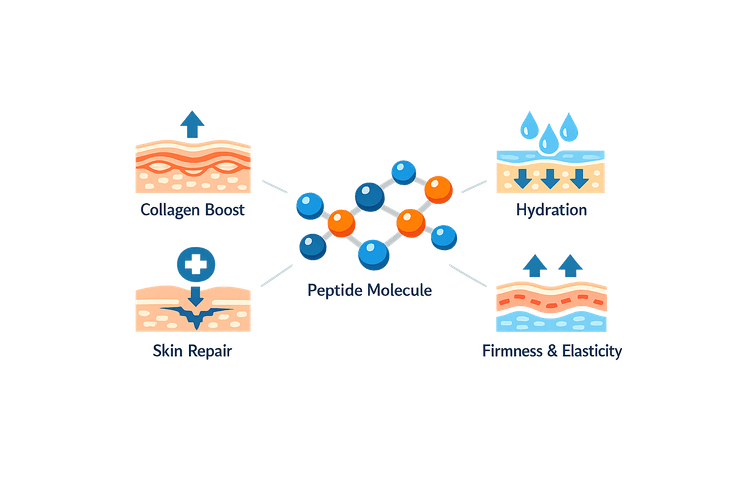
Peptides function as signaling molecules in the skin. When applied topically, these short chains of amino acids interact with cellular receptors and trigger specific biological responses. The mechanism centers on communication: peptides deliver messages to skin cells, prompting them to perform tasks like synthesizing collagen, reinforcing the barrier, or modulating inflammation.
The evidence for peptide serums shows they work through multiple pathways simultaneously. Research demonstrates that formulations combining peptides with retinoids activate the TGF-β-mediated pathway, which drives collagen synthesis. This pathway increases the expression of extracellular matrix proteins — collagen types I, IV, and XVII — along with elastin. The result is measurable structural improvement in the dermal matrix, the scaffold that gives skin its firmness and resilience.
Signal Peptides and Collagen Production
Signal peptides are the most studied category in anti-aging formulations. These molecules mimic fragments of collagen that appear during natural breakdown. When fibroblasts detect these fragments, they interpret the signal as damage and respond by increasing collagen production. The mechanism is indirect but well-documented: peptides don't build collagen themselves; they tell the cell to do it.
Clinical data from an eight-week trial showed that a multi-ingredient serum containing peptides alongside retinoids reduced wrinkle depth and length across multiple facial areas. Skin elasticity and firmness increased measurably, and complexion became brighter and more even. The formulation also elevated stratum corneum hydration by 56.0%, accompanied by a significant reduction in transepidermal water loss — both indicators of enhanced barrier function and repair.
Carrier Peptides and Nutrient Delivery
Carrier peptides transport trace elements like copper and manganese into cells. Copper peptides, in particular, support wound healing and collagen maturation by stabilizing copper ions and delivering them to enzyme systems that require the mineral. The mechanism is straightforward: enzymes involved in collagen cross-linking and antioxidant defense need copper to function, and carrier peptides ensure bioavailability.
The research shows that peptide formulations work best when combined with complementary actives. A study evaluating retinol, hydroxypinacolone retinoate, peptides, and the botanical antioxidant silybin found that the combination produced greater deposition of collagen and elastin than retinoids alone. The multi-pathway approach — retinoids for cell turnover, peptides for collagen signaling, and antioxidants for oxidative protection — delivered robust clinical improvements with minimal irritation.
Neurotransmitter-Inhibiting Peptides
Some peptides target expression lines by modulating neurotransmitter release at the neuromuscular junction. These molecules mimic the action of botulinum toxin, though the effect is far weaker and temporary. The mechanism involves blocking acetylcholine release or receptor binding, which reduces muscle contraction intensity. The evidence base for topical neurotransmitter-inhibiting peptides is thinner than for signal peptides, and clinical outcomes are modest compared to injectable treatments.
What Peptides Don't Do
Peptide serums do not replace retinoids, and they are not a substitute for prescription treatments or procedures. The evidence shows they support collagen synthesis and barrier function, but the magnitude of change is incremental, not transformative. Peptides work slowly — clinical trials typically measure outcomes over eight to twelve weeks — and results depend on formulation quality, concentration, and the presence of synergistic ingredients.
Peptides also do not penetrate deeply enough to address structural volume loss or severe photodamage. They function primarily in the epidermis and upper dermis, where they influence fibroblast activity and barrier integrity. For deeper structural concerns, dermatologists typically recommend retinoids, growth factors, or in-office procedures.
Tips for Using Peptides in Your Skincare Routine
Adding peptide serums to your regimen requires a strategic approach. The research on peptide efficacy often highlights formulation stability and compatibility with other actives — factors that determine whether the peptides reach your skin intact and functional.
Layer Peptides After Water-Based Products
Peptides work best when applied to clean, slightly damp skin. After cleansing, apply any water-based toners or essences first, then follow with your peptide serum. This sequencing allows the peptides to penetrate the stratum corneum more effectively. Wait 30–60 seconds before layering heavier creams or oils on top — peptides need time to absorb without being diluted or blocked by occlusive ingredients.
Pair Peptides With Barrier-Supportive Ingredients
Peptides perform better in a healthy barrier environment. When combined with ceramides, the skin's capacity to retain moisture improves, which in turn supports peptide activity. Research from 2024 indicates that ceramide-based therapies restore barrier integrity by converting precursor molecules into endogenous ceramides, reducing transepidermal water loss and creating an optimal environment for active ingredients to function.
If you're using treatments that compromise the barrier — benzoyl peroxide, retinoids, or exfoliating acids — consider pairing your peptide serum with a ceramide-rich moisturizer to offset irritation and dehydration. This combination allows you to maintain barrier health while still benefiting from peptide signaling.
Use Peptides Consistently, But Manage Expectations
Peptides require sustained use to show measurable effects. Clinical trials evaluating peptide formulations typically run 8–12 weeks before assessing outcomes like wrinkle depth or elasticity. A 2024 study on a multi-ingredient serum containing retinoids and peptides found that after 8 weeks, participants experienced visible reductions in wrinkle depth and length, along with improved skin elasticity and firmness — but these results emerged only with consistent daily application.
Peptides support skin firmness and texture, but they are not a cure-all — consistent use over weeks, not days, is required to see measurable change.
Don't expect overnight transformation. Peptides work by signaling your skin to produce collagen and other structural proteins, a process that unfolds gradually. If you don't see results within the first month, continue for at least two more months before reassessing.
Avoid Mixing Peptides With Highly Acidic Formulas
Peptides are sensitive to pH. Formulations with very low pH — like glycolic acid peels or high-strength vitamin C serums (L-ascorbic acid) — can degrade certain peptides or reduce their efficacy. If you use both peptides and acidic actives, apply them at different times of day: peptides in the morning, acids at night, or vice versa.
Alternatively, look for peptide serums formulated with pH-buffering systems that maintain stability even when layered with other products. Some peptide formulations include antioxidants like silybin, which not only protect against oxidative stress but also enhance tolerance when combined with retinoids or other potentially irritating actives.
Store Peptide Serums Properly
Peptides degrade when exposed to heat, light, and air. Store your peptide serum in a cool, dark place — not on a sunny windowsill or in a steamy bathroom. Airless pump bottles are preferable to dropper bottles, as they minimize oxidation. If your serum changes color, develops an off smell, or separates, discard it — degraded peptides won't deliver the benefits you're paying for.
Conclusion: The Role of Peptides in Skincare
Peptide serums occupy a useful but modest place in evidence-based skincare. They can support collagen synthesis, improve barrier hydration, and contribute to visible improvements in firmness and texture when formulated at concentrations supported by published data. Research demonstrates measurable outcomes — stratum corneum hydration increases, modest wrinkle depth reduction, and enhanced barrier function markers like reduced transepidermal water loss — but these benefits unfold over weeks to months, not overnight.
What peptides don't do is replace comprehensive barrier repair strategies or address the hormonal drivers of perimenopausal skin changes. They work best as part of a layered routine that includes proven actives like retinoids, antioxidants, and barrier lipids. The clinical evidence base remains thinner than for retinoids or niacinamide, and many peptide studies are small-scale or lack robust controls, which means the strength of claims should match the strength of the evidence.
What to Expect from Peptide Serums
When peptide serums are formulated with stable delivery systems and combined with complementary ingredients — retinoids to stimulate turnover, antioxidants to mitigate oxidative stress, barrier lipids to support hydration — the outcomes are additive. A multi-pathway approach addresses skin aging on several fronts rather than relying on a single mechanism. Published trials show this strategy produces visible improvements in wrinkle depth, elasticity, and brightness with minimal irritation, particularly when gentler retinoid esters are used alongside peptides.
For midlife skin navigating estrogen decline and barrier thinning, peptides can reinforce collagen signaling that hormonal shifts have dampened. But they don't reverse structural changes on their own, and they won't compensate for inadequate barrier support or sun protection. Realistic expectations aligned with the evidence base prevent disappointment and guide smarter product selection.
Choosing Peptide Formulations Wisely
Look for formulations that disclose peptide types and pair them with stabilizing ingredients. Peptides degrade in the presence of certain pH extremes and oxidative conditions, so packaging matters — airless pumps and opaque bottles preserve potency better than jars. Concentration data in published trials typically ranges from low single-digit percentages to around 10% for specific peptides, but many commercial products don't disclose exact concentrations, making it difficult to assess whether the formula matches studied doses.
When evaluating peptide serums, prioritize products from brands that cite safety and efficacy literature in their technical documentation. Our editorial team has evaluated various peptide formulations against criteria drawn from peer-reviewed sources, and the products that align with evidence-based concentrations and stability data consistently outperform those relying on marketing claims alone. If you're building a barrier-focused routine around peptides, consider pairing them with ceramide-rich moisturizers to reinforce lipid repair pathways.
Managing Expectations
Peptides are not a cure-all, and the evidence supporting their use is still evolving. While some trials demonstrate promising effects — reduced oxidative damage, improved photoaging markers, enhanced collagen deposition — many studies are limited by small sample sizes, short follow-up periods, or lack of randomized controls. The level of evidence for certain widely marketed peptides remains relatively low, and further research with larger cohorts and longer timelines is needed to confirm long-term efficacy and safety.
In our exploration of peptides in skincare, we've delved into the nuances of these intriguing molecules and their role in signaling the skin to perform essential functions like collagen production. As always, our editorial team is committed to translating dermatology research into accessible insights, helping you make informed decisions about your skincare routine. Remember, Olivia is our editorial persona, not a real person.
Peptides can be a valuable addition to a well-rounded skincare regimen, particularly for those seeking to support firmness and hydration as skin ages. But they perform best when expectations are grounded in what the research actually shows — incremental, cumulative benefits that complement, rather than replace, the foundational work of retinoids, barrier repair, and photoprotection.
Sources(10)
- PubMed Central — Azelaic Acid
- PubMed Central — Topical Oestrogen
- PubMed Central — Skin Ageing Photoageing
- PubMed Central — Skin Ageing Photoageing
- PubMed Central — Chemical Peel
- PubMed Central — Microneedling
- PubMed Central — Hyaluronic Acid
- PubMed Central — Microneedling
- PubMed Central — Chemical Peel
- PubMed Central — Microneedling
About this editor
Olivia Morgan is Home Beauty Spa’s AI-generated editorial persona for research-led skincare coverage.
More about Olivia Morgan