
Regenerative Beauty: A Guide to True Skin Recovery

Top takeaways
- Regenerative beauty represents a shift from corrective approaches to biologically oriented strategies that restore tissue quality and function
- True skin recovery involves modulating the extracellular matrix, mechanotransduction, and immune balance rather than simply adding volume or stimulating isolated collagen production
- Bioregenerative agents like polynucleotides and PDRN work through biological signaling pathways that enhance angiogenesis and fibroblast migration
- Evidence-based regenerative skincare focuses on ingredients that actively participate in the skin's natural repair processes
On this page
Introduction
You've noticed your skin doesn't bounce back the way it used to. A breakout leaves a mark that lingers for weeks. Your moisturizer sits on the surface instead of sinking in. The barrier feels compromised, and nothing you try seems to rebuild what's been lost.
This is where regenerative beauty diverges from conventional skincare. According to a 2024 review published in aesthetic medicine literature, regeneration in this context should be understood as a functional, biologically driven process rather than a simple consequence of volumetric correction or isolated neocollagenesis. The evidence supports a paradigm shift toward interventions that modulate the extracellular matrix, mechanotransduction, immune balance, and dermal–hypodermal interactions to promote genuine tissue recovery.
Our editorial team evaluates regenerative ingredients against criteria drawn from cited safety and efficacy literature, ensuring that the products we discuss truly align with the principles of regenerative beauty. In the realm of regenerative skincare, we often find ourselves delving into the intricate mechanisms that support true skin repair—how retinoids promote cell turnover, how peptides support collagen production, and how ceramides reinforce the barrier repair function essential for retaining moisture and protecting against environmental aggressors.
The research distinguishes between repair, remodeling, and true regeneration. Bioregenerative agents—including polynucleotides, polydeoxyribonucleotide (PDRN), and extracellular vesicles—act predominantly through biological signaling rather than scaffold formation. Experimental and clinical studies report enhanced angiogenesis, fibroblast migration, and modulation of inflammatory responses following administration of these agents, frequently linked to purinergic receptor activation and growth factor pathways.
What Makes Skincare Truly Regenerative
The term "regenerative" has been applied broadly in skincare marketing, often without biological precision. Here's what the research actually says: regenerative interventions target multiple tissue layers and biological pathways simultaneously. They don't just fill space or stimulate a single cellular response—they create an environment where tissue quality, function, and structural integrity can improve over time.
Extracellular vesicles, particularly exosomes, represent the closest concept to true regeneration discussed in current literature. By transferring proteins, lipids, and microRNAs, these structures can directly modulate cellular, epigenetic, and immunological pathways involved in tissue regeneration. Experimental studies demonstrate relevant effects on angiogenesis, reduction of oxidative stress, and immune modulation.
Additionally, emerging evidence points to systemic factors that influence skin health. The kidney-derived master anti-aging protein klotho serves as a systemic "shield" for the skin, linking whole-body rejuvenation to dermal resilience. Recent studies in aged non-human primates have demonstrated that systemic klotho levels correlate with cognitive resilience, providing a basis for its potential role in systemic and skin-specific regeneration.
This guide will walk you through the evidence-based framework for building a regenerative skincare routine—one that adapts to the evolving needs of your skin in your 30s and 40s, when hormonal shifts and cumulative environmental exposure begin to outpace your skin's natural repair capacity.
Prerequisites
Before you begin building a regenerative beauty routine, you need a working understanding of what regeneration actually means in skincare — and what it doesn't. The term has been applied liberally across aesthetic medicine, often without biological precision. Recent research clarifies that true regeneration involves functional, biologically driven processes that restore tissue quality and structural integrity, rather than simple volumetric correction or isolated collagen stimulation.
Understanding this distinction matters because it shapes which ingredients and approaches you prioritize. Regenerative skincare targets the extracellular matrix, immune balance, and dermal–hypodermal interactions — the deeper systems that govern how skin repairs itself over time. This is different from surface hydration or temporary plumping.
Essential Knowledge: What Regeneration Requires
To implement regenerative beauty practices effectively, you need to understand the biological mechanisms at play. Regeneration in skin involves several coordinated processes: angiogenesis (new blood vessel formation), fibroblast migration and activation, modulation of inflammatory responses, and reduction of oxidative stress. These processes don't happen in isolation — they require signaling molecules, structural scaffolds, and a balanced immune environment.
The most biologically substantiated tools for long-term functional remodeling currently include particulate biostimulators, bioregenerative agents like polynucleotides and polydeoxyribonucleotides, and extracellular vesicles. Each works through distinct pathways. Particulate biostimulators create a scaffold that triggers controlled inflammation and collagen remodeling. Bioregenerative agents act primarily through biological signaling — they enhance fibroblast migration, support purinergic receptor activation, and modulate inflammation without forming a physical structure.
Extracellular vesicles, particularly exosomes, represent the closest concept to true regeneration discussed in current literature. These structures transfer proteins, lipids, and microRNAs directly into cells, modulating cellular, epigenetic, and immunological pathways involved in tissue regeneration. Experimental studies demonstrate relevant effects on angiogenesis and reduction of oxidative stress.
Tools and Ingredients to Recognize
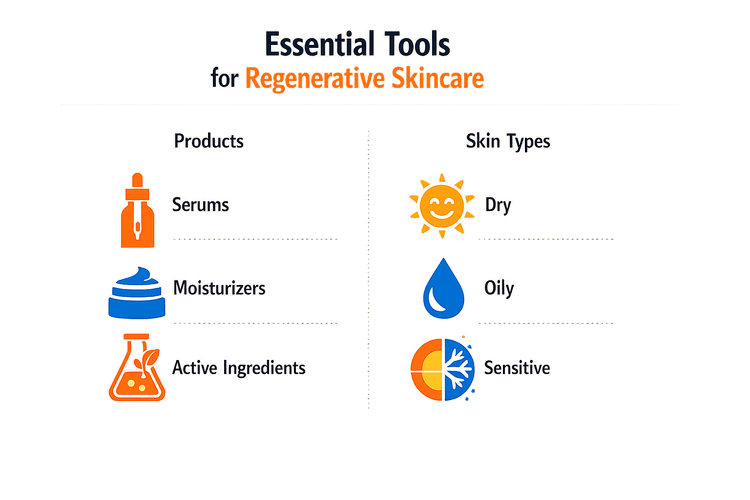
You don't need to stock a full aesthetic clinic to work regeneratively. What you do need is the ability to identify ingredients and formulations that operate through biological signaling rather than purely mechanical or surface effects. Look for products that support barrier repair, modulate inflammation, and provide structural lipids — ceramides, peptides, and certain antioxidants fit this profile.
Our team evaluates these ingredients against criteria drawn from safety and efficacy literature, ensuring that the products we discuss align with the principles of regenerative beauty. For instance, barrier repair creams that combine ceramides, cholesterol, and fatty acids in physiologic ratios support the skin's own repair mechanisms rather than simply occluding the surface.
Retinoids promote cell turnover, a crucial part of skin regeneration. Peptides support collagen production, enhancing structural integrity. Ceramides reinforce the skin barrier, essential for retaining moisture and protecting against environmental aggressors. These aren't passive moisturizers — they actively participate in the skin's recovery process.
Regenerative skincare is not about forcing the skin to do something unnatural; it's about supporting the biological processes already encoded in tissue repair.
What You Should Know Before Starting
Before you introduce regenerative practices, assess your current skin state. If your barrier is compromised — you're experiencing persistent dryness, sensitivity, or reactivity — address that first. Regenerative processes require a stable foundation. A disrupted barrier leaks moisture, allows irritants in, and creates chronic low-grade inflammation that works against repair.
You should also understand that regeneration is a timeline, not an event. Functional remodeling takes weeks to months, depending on the intervention and your skin's baseline condition. Expecting overnight transformation sets you up for disappointment and product-hopping, which disrupts the very consistency regenerative approaches require.
Finally, recognize that regenerative beauty adapts to the evolving needs of your skin in your 30s and 40s. Hormonal shifts, cumulative sun exposure, and natural collagen decline all influence how your skin responds to active ingredients. What worked at 28 may need adjustment at 42 — not because the science changed, but because your skin's biology did.
Step-by-Step Guide to Regenerative Skincare
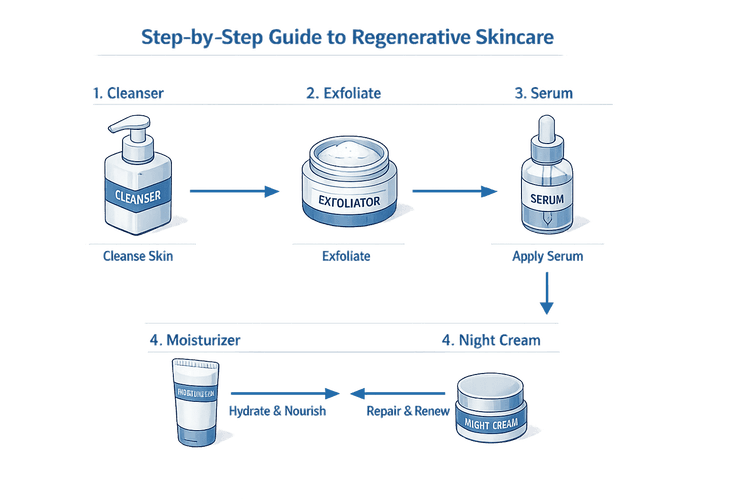
Building a regenerative beauty routine requires a methodical approach that prioritizes barrier repair and cellular support over quick fixes. The steps below translate the science of skin recovery into a practical framework you can implement immediately.
Step 1: Establish Your Baseline Barrier Function
Before introducing regenerative actives, evaluate your skin's starting point. Look for signs of barrier compromise: persistent tightness after cleansing, reactive flares to previously tolerated products, or visible dryness that moisturizer no longer resolves. Document these observations—regenerative protocols work incrementally, and tracking changes over weeks reveals patterns invisible day-to-day.
If your barrier shows significant disruption, pause all exfoliating acids and retinoids temporarily. The first phase of regenerative skincare is stabilization, not acceleration.
Step 2: Build the Lipid Foundation
Ceramides, cholesterol, and fatty acids in a 3:1:1 ratio mimic the skin's natural lipid structure. Apply a ceramide-rich formulation twice daily on damp skin—this occludes moisture and provides the raw materials fibroblasts need for repair. Clinical evidence shows barrier recovery timelines shorten measurably when lipid ratios match endogenous composition.
Step 3: Activate Fibroblast Signaling
Once your barrier tolerates consistent lipid application without reactivity (typically 2–3 weeks), introduce peptides or growth-factor analogs in the evening routine. These molecules stimulate fibroblast activation and collagen synthesis—the cellular machinery behind true regeneration. Research on platelet-derived growth factors shows they enhance dermal remodeling when the barrier is intact enough to permit penetration without triggering inflammation.
Start with every third night. Monitor for increased sensitivity or redness; if either appears, reduce frequency and reinforce lipid support.
Step 4: Support Cellular Turnover
Retinoids promote cell turnover and are well-documented regenerative actives, but timing matters. Wait until your barrier shows consistent stability—no tightness, no reactive flares—before reintroducing retinoids. Begin with a low-strength formulation (consult your dermatologist for appropriate concentration) applied once or twice weekly, always followed by your lipid layer. The goal is controlled turnover that supports regeneration without compromising the barrier you've rebuilt.
Step 5: Enhance Vascularization and Delivery
The MSC secretome and exosome research points to the importance of vascularization in dermal remodeling—better blood flow delivers nutrients and removes metabolic waste, accelerating recovery. While clinical-grade therapies remain in professional settings, at-home practices like gentle facial massage and consistent hydration support microcirculation. Apply actives to slightly damp skin and use gentle upward strokes to encourage lymphatic drainage.
This step amplifies the efficacy of the peptides and growth-factor analogs you introduced in Step 3.
Step 6: Monitor and Adjust
Regenerative skincare operates on dermal timelines, not epidermal ones. Collagen synthesis and barrier remodeling require 8–12 weeks of consistent application before visible changes emerge. Photograph your skin in consistent lighting monthly. Compare texture, tone evenness, and resilience to environmental stressors. If progress stalls, revisit Step 2—barrier integrity often needs reinforcement before advancing to higher-potency actives.
The evidence base for regenerative beauty is strongest when protocols layer sequentially: stabilize the barrier, activate fibroblasts, support turnover, and sustain the cycle.
Adapting the Protocol for Hormonal Skin Changes
Perimenopausal and menopausal skin loses barrier lipids and collagen density simultaneously. If you're navigating estrogen decline, extend the lipid-building phase (Step 2) to 4–6 weeks before introducing actives. The barrier thins measurably during this transition, and rushing regenerative actives onto a compromised foundation triggers sensitivity that derails the entire protocol.
Our team evaluates regenerative ingredients against the criteria drawn from cited safety and efficacy literature, ensuring that the actives discussed here align with the principles of barrier-first recovery. By focusing on these evidence-based steps, you can build a routine that adapts to your skin's evolving needs in your 30s and 40s.
Troubleshooting Common Issues
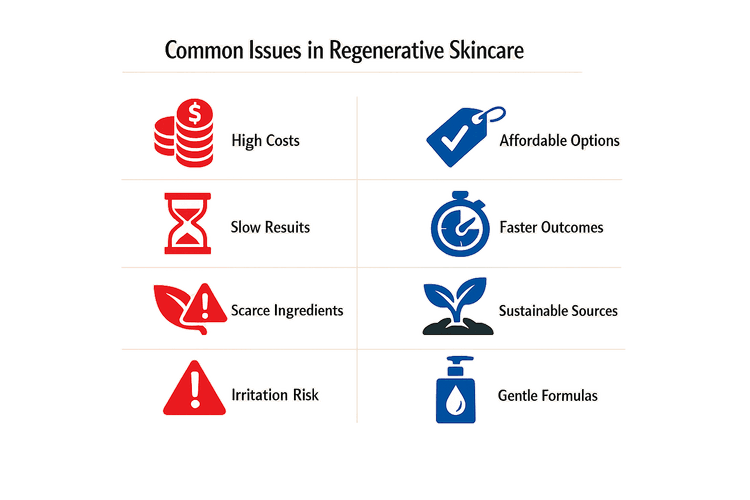
Starting a regenerative beauty routine rarely follows a straight path. You've chosen barrier-supportive ingredients and followed the protocol, yet your skin feels tight, reactive, or unchanged after weeks of consistent use. Here's what the research shows about the most common obstacles — and how to navigate them without abandoning the approach.
Initial Irritation or Sensitivity
When you introduce actives that promote cell turnover or modulate barrier function, temporary sensitivity is common. Your skin may feel warm, slightly red, or more reactive to products that previously caused no issue. This reflects the biological transition period as your barrier adapts to new signaling pathways.
The solution is titration. Start with lower concentrations or less frequent application, then increase gradually as tolerance builds. If you're using multiple actives, introduce them one at a time over several weeks so you can isolate any problematic ingredient. Pair actives with barrier-supportive ingredients like ceramides to buffer the transition — research shows that reinforcing lipid structures reduces transepidermal water loss during the adaptation phase.
No Visible Progress After Four to Six Weeks
You've been consistent, but your skin looks the same. Before concluding the approach isn't working, assess whether you're addressing the right biological target. Regenerative beauty is not a volumetric correction strategy — it modulates tissue quality and function through extracellular matrix remodeling, mechanotransduction, and immune balance. These changes occur at the cellular level before they become visible.
Check your formulation choices. Are the actives present at effective concentrations? Are you pairing them with delivery systems that support penetration? If you're relying solely on one ingredient class, consider whether your barrier needs multi-modal support. For example, retinoids promote cell turnover, but without adequate lipid reinforcement, the new cells may not form a competent barrier. If barrier dysfunction is the underlying issue, explore barrier repair creams that combine ceramides, cholesterol, and fatty acids in physiologic ratios.
Regenerative interventions work through biological signaling, not immediate structural change — patience is part of the protocol.
Timeline expectations matter. Skin cell turnover takes approximately 28 days in younger skin and extends beyond 40 days as we age. Visible improvements in texture, tone, and resilience typically emerge after two to three full turnover cycles — meaning eight to twelve weeks of consistent use. If you're evaluating progress too early, you're measuring noise rather than signal.
Increased Dryness or Flaking
Flaking and dryness often indicate that your routine is accelerating desquamation without adequate hydration and lipid support. Cell turnover is increasing, but the new cells aren't retaining moisture effectively. This is a formulation imbalance, not a failure of the regenerative approach.
Increase occlusive and humectant layers. Add a hyaluronic acid serum under your barrier cream, and consider a final occlusive step in the evening to prevent transepidermal water loss overnight. If flaking persists, reduce the frequency of exfoliating actives and ensure you're not over-cleansing — harsh surfactants strip the lipid barrier and counteract regenerative progress.
Breakouts or Congestion
Some individuals experience increased breakouts when introducing richer barrier creams or occlusive ingredients. This typically reflects pore congestion rather than a true adverse reaction to the regenerative approach. The solution is ingredient selection: choose non-comedogenic emollients and avoid heavy oils if you're prone to congestion.
If breakouts coincide with the introduction of a specific active, consider whether it's triggering a purging phase (common with retinoids as they accelerate turnover and bring underlying congestion to the surface) or a true sensitivity reaction. Purging resolves within four to six weeks as the skin clears; sensitivity reactions persist and worsen with continued use. The distinction determines whether you continue or reformulate.
Persistent Redness or Inflammation
Chronic redness that doesn't resolve after the initial adaptation period suggests your routine may be overloading inflammatory pathways rather than modulating them toward regeneration. Emerging research on extracellular vesicles and exosomes shows that regenerative platforms work by modulating inflammation and oxidative stress, not by forcing the skin into a perpetual reactive state.
Strip your routine back to basics: a gentle cleanser, a simple barrier cream, and sunscreen. Once redness subsides, reintroduce actives one at a time with at least two weeks between additions. If redness recurs with a specific ingredient, eliminate it and choose an alternative pathway to the same biological goal. For example, if retinoids trigger persistent inflammation, consider peptides or growth-factor analogs that support collagen production through different signaling mechanisms.
Conclusion
Regenerative beauty is not about chasing trends or quick fixes — it's about understanding the biological mechanisms that support true skin recovery and working with them consistently. The research shows that regeneration in aesthetic medicine is a functional, biologically driven process involving extracellular matrix modulation, immune balance, and cellular signaling rather than simple volumetric correction or isolated neocollagenesis.
Our team evaluates regenerative skincare ingredients against criteria drawn from cited safety and efficacy literature, ensuring that the products we discuss align with the principles of true skin repair. Bioregenerative agents like polynucleotides and PDRN enhance skin recovery through biological signaling, promoting angiogenesis and fibroblast migration rather than acting as structural fillers. These agents represent a shift toward interventions that modulate the skin's own repair pathways.
The evidence base for regenerative skincare continues to evolve, with emerging research on extracellular vesicles, exosomes, and systemic longevity factors like klotho demonstrating how deeply interconnected skin health is with whole-body biological processes. While the translational gap between controlled laboratory models and real-world human skin remains significant, the current literature supports a paradigm shift toward interventions that enhance tissue quality, function, and long-term structural integrity.
You've learned the prerequisites for starting a regenerative routine, the step-by-step framework for introducing active ingredients, and the troubleshooting strategies for common challenges. If you're navigating skin changes during perimenopause, these regenerative principles become even more critical as estrogen decline impacts barrier function and repair capacity.
The most effective regenerative routine is the one you can sustain over months and years, adapting as your skin's needs evolve. Start with the fundamentals — barrier repair, gentle exfoliation, and targeted actives — and build from there based on your skin's response and the evidence that supports each ingredient.
Sources(12)
- PubMed Central — Topical Oestrogen
- PubMed Central — Lactic Acid
- PubMed Central — Petrolatum
- PubMed Central — Petrolatum
- PubMed Central — Petrolatum
- PubMed Central — Petrolatum
- PubMed Central — Petrolatum
- PubMed Central — Panthenol
- PubMed Central — Laser Resurfacing
- PubMed Central — Menopausal Skin Changes
- PubMed Central — Niacinamide
- PubMed Central — Niacinamide
About this editor
Olivia Morgan is Home Beauty Spa’s AI-generated editorial persona for research-led skincare coverage.
More about Olivia Morgan