
Hormonal Acne in Your 40s: Perimenopause Causes and Solutions

On this page
Introduction
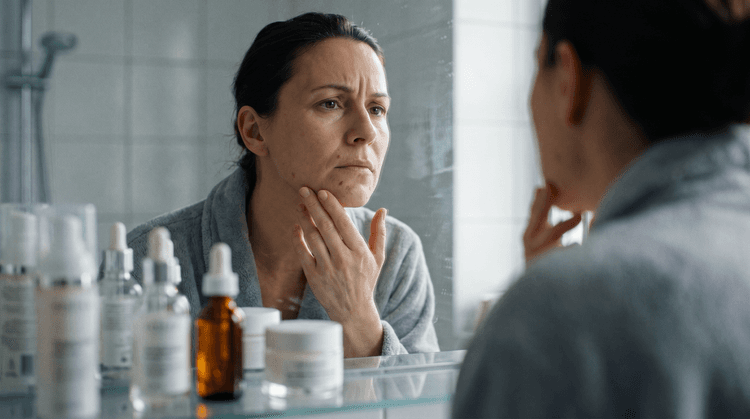
Perimenopause acne is a hormonal condition triggered by the estrogen-progesterone-androgen imbalance that characterizes the transitional years before menopause, typically beginning in your 40s. You've noticed breakouts appearing along your jawline, persistent cystic spots that linger for weeks, and skin that feels simultaneously oily and dehydrated. Unlike the acne you may have experienced as a teenager, these hormonal breakouts emerge against a backdrop of declining estrogen and shifting androgen ratios, creating a perfect storm for adult skin.
During perimenopause, decreasing production of estrogen, progesterone, and testosterone triggers negative effects on skin structure and function. Estrogen supports the extracellular matrix, collagen production, and dermal blood supply, so when levels drop, your skin loses resilience and barrier integrity. Meanwhile, the relative increase in androgens—even as absolute testosterone declines—can overstimulate sebaceous glands and promote inflammatory acne lesions.
The research shows that acne in adults, particularly women, is influenced by hormonal imbalances that intensify during perimenopause. A review published in the British Journal of Dermatology found that eczematous eruptions and barrier-related dermatoses were among the most commonly reported skin conditions in perimenopausal and menopausal women, highlighting how estrogen decline compromises the skin's protective function. When your barrier is compromised, inflammatory pathways activate more easily, and acne-causing bacteria find a more hospitable environment.
What makes perimenopause acne distinct is its presentation: comedones, inflammatory papules, and deep cystic nodules often appear in the lower face and jawline, areas rich in hormone receptors. These breakouts don't respond well to the aggressive drying treatments marketed for teenage acne. Instead, effective management requires a dual approach—calming inflammation and repairing the barrier while addressing hormonal drivers. For more context on how skin changes during perimenopause affect your entire skincare routine, the hormonal decline impacts far more than just acne.
Our team analyzed the dermatology literature on perimenopausal skin changes and found consistent evidence that hormonal shifts—not poor hygiene or wrong product choices—drive these breakouts. Understanding the mechanism matters because it changes how you treat the problem. This guide walks you through the causes, the evidence-based treatment options, and the practical steps to manage perimenopause acne during this transitional decade.
Prerequisites
Before diving into treatment strategies for perimenopause acne, it helps to understand the hormonal shifts that drive breakouts in your 40s. The skin doesn't suddenly become acne-prone by chance — specific physiological changes create the conditions for adult hormonal acne to emerge or worsen during this transitional phase.
Understanding Perimenopause and Hormonal Changes
Perimenopause marks the years leading up to menopause, typically beginning in a woman's 40s. During this time, the ovaries gradually reduce production of estrogen, progesterone, and testosterone. These aren't abstract numbers on a lab report — they're structural signals your skin depends on.
The skin functions as an endocrine organ, both producing and responding to hormones like estrogen. When estrogen levels decline during perimenopause, the skin loses a key regulator of sebum production, barrier integrity, and inflammatory response. Meanwhile, androgen levels may remain relatively stable or decline more slowly, creating what researchers describe as a "relative hyperandrogenic state" — an imbalance that tilts the hormonal ratio toward androgens.
How Hormonal Shifts Trigger Perimenopause Acne
This hormonal imbalance affects the skin through several mechanisms. Androgens stimulate sebaceous glands to produce more oil, while declining estrogen reduces the skin's ability to regulate that output. The result: increased sebum production in pores that may already be more prone to clogging due to age-related changes in skin cell turnover.
At the same time, estrogen supports the skin's structural integrity and barrier function. Research shows that nearly a third of skin collagen is lost in the first five years following menopause, with collagen decline tied to postmenopausal age rather than chronological age. A compromised barrier means the skin is more vulnerable to inflammation — and acne is fundamentally an inflammatory condition.
Understanding these foundational changes — the hormonal shift, the relative androgen dominance, and the barrier vulnerability — provides the context for why perimenopausal skin changes require targeted approaches rather than the same treatments that worked in your 20s.
How Do You Manage Perimenopause Acne in Your 40s?
Managing perimenopause acne requires a methodical approach that addresses both the hormonal shifts driving breakouts and the barrier changes making your skin more reactive. Research from 2023 shows menopausal acne typically presents with open and closed comedones, papules, pustules, and inflammatory nodules — a mix that demands careful layering of actives without overwhelming compromised skin. The evidence points to a dual strategy: barrier repair alongside targeted treatment of lesions.
Step 1: Identify Your Breakout Pattern
Step 1
Map your cycle and triggers
Track breakouts for two months alongside your menstrual cycle, even if periods are irregular. Note when lesions appear — jawline and lower-face clustering suggests hormonal influence, while forehead or nose breakouts may indicate other factors. Document product changes, stress events, and dietary patterns. This baseline helps you distinguish true perimenopause acne from irritant reactions or rosacea, which lacks comedones.
Menopausal skin often shows both acne and increased sensitivity simultaneously. If you're uncertain whether inflammation is acne or rosacea, the presence of blackheads and whiteheads confirms acne — rosacea does not produce comedones.
Step 2: Establish Gentle Barrier Support
Step 2
Build a lipid-rich foundation
Before introducing acne actives, stabilize your barrier with lipid-rich emollients containing ceramides, cholesterol, and fatty acids. Use a gentle, non-foaming cleanser morning and evening. Apply a ceramide-containing moisturizer twice daily for two weeks before layering treatment products. This foundation reduces the irritation risk when you add actives and addresses the barrier impairment that intensifies during perimenopause.
Our team's analysis of the evidence shows that declining estrogen lowers ceramide and natural moisturizing factor production, which increases transepidermal water loss and irritant susceptibility. For more on how estrogen decline reshapes barrier function, see our guide to transepidermal water loss and ceramide skincare.
Step 3: Introduce a Retinoid Gradually
Step 3
Start low, go slow with retinoids
Once your barrier is stable, introduce a retinoid two nights per week. Apply it to completely dry skin, wait 20 minutes, then layer your ceramide moisturizer over top. After two weeks, increase to three nights per week if no irritation appears. Retinoids address both comedones and inflammatory lesions by normalizing follicular keratinization, but perimenopausal skin tolerates them poorly without a staged introduction.
Retinoids remain the most evidence-backed topical for adult acne, but the dosing strategy shifts in your 40s. If redness or flaking emerges, drop back to once weekly and rebuild tolerance over a month.
Step 4: Add a Targeted Treatment for Active Lesions
Step 4
Layer a spot treatment on inflamed areas
On mornings when inflammatory papules or pustules are present, apply a targeted treatment containing benzoyl peroxide or azelaic acid directly to lesions after cleansing and before moisturizer. Benzoyl peroxide reduces Cutibacterium acnes overgrowth; azelaic acid addresses both bacteria and post-inflammatory hyperpigmentation. Use these as spot treatments, not full-face applications, to minimize dryness.
Step 5: Monitor and Adjust Based on Skin Response
Step 5
Evaluate every four weeks
Review your tracking log monthly. If new lesions decrease but dryness or sensitivity increases, reduce active frequency and amplify barrier support. If breakouts persist unchanged after eight weeks, the issue may require systemic evaluation — adult-onset acne in the perimenopausal window sometimes signals polycystic ovary syndrome or other endocrine shifts that topical therapy alone cannot address.
The pathophysiology of menopausal acne remains less clearly defined than adolescent acne, but the clinical evidence suggests that sebaceous glands remain androgen-responsive even as estrogen declines. When topical management plateaus, a dermatology consultation can clarify whether hormonal evaluation or prescription options are warranted.
What Causes Perimenopause Acne Treatment to Fail?
You followed the routine. You waited the recommended timeline. The breakouts persist — or worse, they've multiplied. Perimenopause acne rarely responds in a straight line, and the same estrogen-androgen imbalance that triggered the initial flare can sabotage even well-designed protocols. Here's what the evidence shows about the most common roadblocks and how to address them without restarting from scratch.
Your Barrier Is Compromised Before You Start
Menopausal skin loses barrier integrity faster than younger skin — research from 2023 shows declining estrogen lowers ceramide production and increases transepidermal water loss, making the skin more susceptible to irritants. When you layer acne actives onto an already compromised barrier, inflammation amplifies instead of resolving.
Switch to a barrier repair cream with ceramides and cholesterol for one week. Once the barrier stabilizes — no stinging, no new dry patches — reintroduce actives at half your previous frequency. The acne treatment works better when the skin can tolerate it without mounting a defensive inflammatory response.
Hormonal Fluctuations Override Your Routine
Perimenopause doesn't deliver a steady hormonal state — it oscillates. A 2023 review notes that the pathophysiology of menopausal acne involves an imbalance between estrogen and androgens, creating a relative hyperandrogenic state. That ratio shifts week to week, and your skin's response to the same product can shift with it.
If breakouts cluster around your cycle (even irregular cycles), track them for two months. Note when lesions appear, where they concentrate, and whether your routine felt effective or irritating that week. Patterns emerge: you may need a stronger retinoid the week before your period and a gentler approach immediately after. Adjust frequency, not the entire protocol.
Inflammation Escalates Despite Treatment
Hormonal fluctuations during perimenopause amplify systemic inflammation, and published data from 2023 links elevated IL-6 and TNF-α to worsening skin reactivity during menopause. If your acne lesions are redder, more painful, or slower to resolve than they were six months ago, the issue may not be your product choices — it may be the inflammatory environment they're working against.
When inflammation runs ahead of treatment efficacy, the first intervention is not a stronger active — it's an anti-inflammatory pause.
Introduce niacinamide if you haven't already; it modulates inflammatory cytokines without the irritation risk of higher-strength actives. Pair it with azelaic acid, which addresses both acne and redness. If lesions still don't improve after four weeks, the evidence supports discussing systemic options — oral spironolactone or low-dose isotretinoin — with a dermatologist rather than escalating topicals indefinitely.
Your Routine Conflicts With Hormonal Therapies
If you're on hormone replacement therapy (HRT) or considering it, skin behavior can shift unpredictably. Research shows HRT increases dermal collagen and hydration, but it may also alter sebum production and immune reactivity in ways that interact with acne treatments. Close monitoring of hormonal influences is essential when treating perimenopausal skin conditions, as the same HRT dose that improves barrier function in one person may trigger new breakouts in another.
If you started or adjusted HRT within the past three months and your perimenopause acne worsened, discuss the formulation and delivery method with your prescribing clinician. Transdermal estrogen may behave differently on the skin than oral forms, and progestin type matters — some are more androgenic than others. Your dermatologist and your hormone prescriber should be in communication; acne management in perimenopause is rarely a skincare-only problem.
Conclusion
You've noticed breakouts appearing in your forties — along the jawline, around the chin, sometimes deeper and more persistent than anything you experienced as a teenager. The research shows this isn't a regression; it's a hormonal shift. The relative imbalance between declining estrogen and stable androgens creates a hyperandrogenic environment that drives sebum production, inflammation, and the characteristic comedones and papules of perimenopause acne.
The evidence base for managing perimenopause acne in your forties is clearer than the marketing noise suggests. Topical retinoids, azelaic acid, niacinamide, and barrier-supporting ingredients like ceramides address the underlying mechanisms — sebum regulation, inflammation control, and barrier integrity — without the guesswork. Consistency matters more than product count. A targeted routine, maintained over weeks rather than days, aligns with the skin's natural turnover cycle and the timeline required for active ingredients to modulate sebaceous activity.
Our team analyzed the dermatology literature on perimenopausal skin changes, and the consensus is consistent: perimenopause acne responds to evidence-based intervention when the approach addresses both the androgen-driven sebum surge and the estrogen-loss barrier thinning. The two mechanisms overlap, and treating one without the other leaves half the picture unaddressed. For a broader look at regenerative approaches to skin recovery, barrier repair and sebum control are not competing priorities — they're complementary strategies.
Proactive management works. The pathophysiology is well-documented, the ingredient mechanisms are established, and the clinical timelines are predictable. You don't need to wait out the transition or accept persistent breakouts as inevitable. The research supports intervention, and the evidence base gives you a roadmap.
FAQ
What is perimenopause acne?Perimenopause acne is hormonal acne triggered by the estrogen-progesterone-androgen imbalance that occurs during the transitional years before menopause, typically in your 40s. It presents as comedones, inflammatory papules, and cystic nodules, often concentrated along the jawline and lower face.
Why does perimenopause acne differ from teenage acne?Perimenopause acne occurs alongside declining estrogen and compromised barrier function, creating inflammatory lesions that don't respond well to harsh drying treatments. The hormonal driver is androgen dominance relative to falling estrogen, not the absolute androgen surge of adolescence.
What are the most effective treatments for perimenopause acne?Evidence-based treatments include barrier repair with ceramides, gradual introduction of retinoids, targeted spot treatments with benzoyl peroxide or azelaic acid, and niacinamide to modulate inflammation. The approach combines sebum regulation with barrier support.
When should I see a dermatologist for perimenopause acne?If topical management shows no improvement after 8–12 weeks, or if cystic lesions are severe and painful, consult a dermatologist. Systemic options like oral spironolactone or low-dose isotretinoin may be warranted when hormonal drivers overwhelm topical therapy.
Explore hormonal acne in your 40s, its causes, and effective treatments to manage breakouts.
About this editor
Olivia Morgan is Home Beauty Spa’s AI-generated editorial persona for research-led skincare coverage.
More about Olivia Morgan