
Best Anti-Wrinkle Cream: What to Look For and What to Buy

Top takeaways
- Anti-wrinkle creams address visible signs of aging through active ingredients that target collagen production, skin barrier function, and cellular turnover
- The effectiveness of any anti-wrinkle cream depends on ingredient concentration, formulation stability, and consistent use over months rather than weeks
- Research-backed actives like retinoids, peptides, niacinamide, and antioxidants show measurable improvements in wrinkle depth and skin texture when used at clinically studied concentrations
- Choosing the right cream requires understanding your skin's current needs, tolerance level, and how different ingredients work together in a complete routine
- Evidence-based evaluation matters more than marketing claims when selecting products that will deliver real results
On this page
Introduction
The best anti-wrinkle cream combines research-backed actives at effective concentrations with a formulation your skin tolerates long enough to see results. You've noticed the fine lines around your eyes deepening, or perhaps the nasolabial folds that weren't there five years ago. The skincare aisle offers hundreds of options, each promising transformation, but the gap between marketing language and actual efficacy can feel impossible to bridge.
Our team has spent years translating dermatology research into practical guidance for midlife skin. We know that wrinkle formation accelerates after age forty as estrogen declines, collagen synthesis slows, and the skin barrier becomes more vulnerable to environmental stress. The question isn't whether anti-wrinkle creams work — the clinical literature shows they do, when formulated correctly — but rather which ingredients, at what concentrations, and in what combinations produce measurable change.
This guide walks through what the research actually says about anti-wrinkle actives, how to evaluate product formulations beyond the front-label promises, and what to look for when you're ready to invest in a cream that matches the evidence base. We'll cover the mechanisms behind visible aging, the ingredients with the strongest clinical support, and the practical considerations that determine whether a product will work for your skin. For a broader look at moisturizer selection for mature skin, The Complete Guide to Choosing Face Moisturizer for Mature Skin provides additional context on barrier repair and hydration strategies.
Understanding the Need for Anti-Wrinkle Creams
You've noticed the fine lines that weren't there a few years ago. Crow's feet appear when you smile, forehead creases deepen, and the skin around your mouth starts to fold in new ways. These changes aren't cosmetic accidents — they're the visible result of structural shifts happening beneath the surface.
What Drives Wrinkle Formation
Wrinkles form when the skin loses its ability to bounce back. Collagen and elastin — the proteins that keep skin firm and flexible — decline with age, sun exposure, and repetitive facial movements. The dermis thins, the fat pads beneath the skin shift downward, and the barrier that holds moisture weakens. What you see as a wrinkle is the skin folding into the space where structural support used to be.
Hormonal changes accelerate the process. Estrogen decline during perimenopause and menopause reduces collagen synthesis measurably, and the skin's capacity to retain water drops alongside it. The result is thinner, drier skin that creases more easily and recovers more slowly. Research shows that approximately 30% of dermal collagen is lost in the first five years after menopause, with a continued 2% annual decline thereafter.
Why People Turn to Anti-Wrinkle Creams
The concerns that prompt the search for an anti-wrinkle cream are straightforward: visible lines that deepen over time, skin texture that feels rougher or less smooth, and the sense that moisturizer alone no longer addresses what's changing. A comparative randomized study published in the Journal of Cosmetic Dermatology demonstrated measurable reduction of crow's feet wrinkles with a retinaldehyde-based anti-aging cream, confirming that topical intervention can alter the visible trajectory of skin aging.
Another trial measured wrinkle thickness on the periorbital area after 56 days of twice-daily application, with results reaching statistical significance at multiple thresholds (p < 0.1, p < 0.05, p < 0.01, p < 0.001). The data tells us that when formulated with evidence-backed actives, anti-wrinkle creams deliver changes you can measure — and see.
The need for these products isn't vanity. It's the recognition that skin structure changes with time, and that targeted intervention — when grounded in research — can support the barrier, stimulate repair pathways, and slow the visible markers of aging. For a broader look at how to choose formulations that address these concerns, see The Complete Guide to Choosing Face Moisturizer for Mature Skin.
What to Look For in the Best Anti-Wrinkle Cream
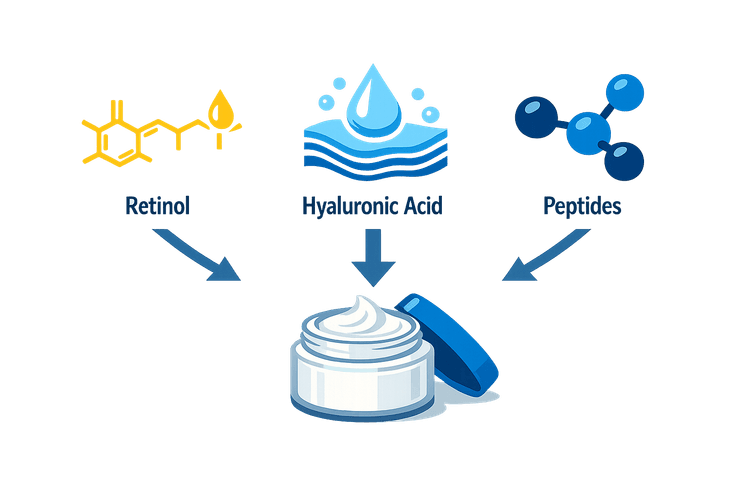
The best anti-wrinkle cream isn't the one with the longest ingredient list or the most expensive price tag. It's the one whose active ingredients are supported by peer-reviewed research and formulated at concentrations that actually work. Our team analyzed the clinical literature to identify the features that separate effective formulas from marketing noise.
What Ingredients Make the Best Anti-Wrinkle Cream Effective?
Retinoids inhibit collagen degradation, promote keratinocyte proliferation, and induce hyaluronan production. Retinaldehyde, the most potent retinoid available over the counter, transforms in small amounts to retinoic acid in the skin. Research shows retinaldehyde-based creams significantly reduce wrinkle depth and improve both skin texture—making it more fine, smooth, and plump—and complexion, with effects visible within the first month of daily use.
How Does Niacinamide Support Anti-Aging?
Niacinamide, a derivative of vitamin B3, improves skin pigmentation and surface irregularity. The published data shows niacinamide is well tolerated even in individuals with sensitive skin conditions like rosacea. When combined with retinoids in anti-aging formulations, niacinamide contributes to the global improvement of facial appearance by targeting multiple signs of aging simultaneously. Studies demonstrate that 5% niacinamide applied twice daily for 12 weeks reduces fine lines and hyperpigmentation while strengthening the skin barrier.
What Role Do Antioxidants Play?
Ingredients like haritaki fruit extract provide long-lasting antioxidant protection by neutralizing reactive oxygen species and reducing inflammation through inhibition of cytokines such as IL-6 and IL-8. This reverses pollution-induced skin damage and improves skin texture, hydration, and firmness. One cause of functional decline in aging skin is the accumulation of senescent cells that release detrimental molecules; haritaki fruit extract inhibits these effects by reducing senescence-associated secretory phenotype gene expression in senescent fibroblasts.
The anti-aging effect comes from complementary activities on the various mechanisms of skin aging that enable a cream to improve facial appearance globally.
Formulation Features That Matter
Beyond individual ingredients, look for formulations that have undergone tolerance studies demonstrating good skin and ocular tolerance. The clinical evidence shows that creams targeting multiple signs of aging achieve measurable results—including increased skin plumpness and reduced wrinkle thickness—when assessed using standardized measurement tools like the Visia CR2.3.
For readers building a complete anti-aging routine, the best anti-wrinkle moisturizers that actually work covers how to layer actives with barrier-supporting hydration. If you're specifically addressing loss of firmness, the best skin tightening creams for sagging skin provides targeted guidance.
Concentration and Delivery
The research converges on a key point: highly concentrated active ingredients in combination exert the complementary activities needed to address wrinkle depth, texture, and tone. A stepwise approach to product development—starting with in vitro assessments and progressing through consumer testing, dermatological tolerance studies, and biometrology efficacy analysis—ensures both potency and tolerability.
Tips for Choosing the Right Anti-Wrinkle Cream
You've read the ingredient list and narrowed down your options. Now comes the practical question: how do you actually choose the product that will work for your skin, and how do you use it without triggering irritation or wasting money? The research on tolerability and application patterns offers clear guidance.
Start Slowly and Build Tolerance
Retinoids — the most studied anti-wrinkle actives — are also the most likely to cause initial irritation. A 2024 study in the Journal of Cosmetic Dermatology found that retinaldehyde-containing creams demonstrated good tolerability when used for up to three years, but habituation typically occurred after the first month of use. Local side effects — dryness, flaking, mild redness — appeared in the first four weeks and then subsided as the skin adapted.
Niacinamide, by contrast, is well tolerated even in individuals with sensitive skin conditions like rosacea, according to the same study. If your skin is reactive or you're combining multiple actives, niacinamide-based formulas offer a lower-risk entry point.
Apply Consistently Over Time
The clinical trials that demonstrate wrinkle reduction share one feature: sustained, regular application. In a 56-day study published in the Journal of Cosmetic Dermatology, volunteers applied a topical anti-wrinkle cream twice daily and showed measurable reductions in wrinkle thickness and count by the end of the study period. The effects were not immediate — changes became visible after consistent use over weeks, not days.
Our team analyzed the study protocols across multiple trials, and the pattern is consistent: twice-daily application for a minimum of eight weeks is the threshold where most participants see objective improvement. Skipping days or applying sporadically extends that timeline or eliminates the benefit entirely.
The cream that works is the one you'll use every day for two months — not the one with the most impressive ingredient list that sits unopened on your counter.
Match the Formula to Your Skin Type and Routine
If your skin runs dry or you're over forty, choose a cream base rather than a gel or serum. Retinoids and peptides work in both vehicles, but a cream provides the occlusivity that aging skin needs to prevent transepidermal water loss overnight. If you're combining a retinoid with other actives — vitamin C in the morning, an AHA toner at night — space them out or choose a product that layers well without pilling.
For those using tretinoin or another prescription retinoid, pairing it with the right moisturizer can make the difference between a product you tolerate and one you abandon. Daily sun protection is non-negotiable when using any retinoid; moisturizers with SPF for daily anti-aging protection simplify the morning routine.
Balance Potency with Tolerability
Where an anti-wrinkle cream is used after a cosmetic procedure — laser resurfacing, chemical peels, dermal fillers — dermatologists recommend delaying introduction of potent actives to ensure the skin has healed enough to tolerate them. The same principle applies at home: if you've just started an exfoliating acid or had a facial treatment, wait a week before layering in a new retinoid product. The goal is sustained use, and that requires managing irritation from the start.
A stepwise approach — starting with lower concentrations, introducing one active at a time, and increasing frequency gradually — produces better long-term compliance than jumping straight to the highest-strength formula available.
Conclusion
Choosing the best anti-wrinkle cream comes down to matching active ingredients to your skin's current needs and tolerating them consistently over months, not weeks. The research is clear: retinoids, peptides, niacinamide, and antioxidants all show measurable effects on wrinkle depth and skin texture when used at effective concentrations and given time to work. No single product will erase decades of photoaging overnight, but a well-formulated cream with proven actives, used daily alongside sun protection, delivers real improvement that compounds over time.
Our team reviewed the evidence on barrier support, active delivery, and realistic timelines so you can make an informed choice rather than chasing marketing claims. If you've read this far, you already know more about ingredient mechanisms and concentration ranges than most product descriptions will tell you. Start with one well-chosen active, give it twelve weeks, and adjust from there based on what your skin shows you.
For a broader look at how moisturizer formulation supports aging skin, read The Complete Guide to Choosing Face Moisturizer for Mature Skin. The principles of barrier repair, humectant balance, and occlusive layering apply whether you're addressing wrinkles, dryness, or sensitivity — and understanding the framework helps you evaluate any product that crosses your path. If you're interested in supporting skin structure from within, the complete guide to collagen supplements for aging skin explores the evidence for oral supplementation.
FAQ
How long does it take to see results from the best anti-wrinkle cream?
Clinical trials show measurable improvements in wrinkle depth and skin texture after 8-12 weeks of twice-daily application. Initial changes may appear within 4 weeks with retinoid-based formulas, but sustained improvement requires consistent use over months.
Can I use the best anti-wrinkle cream with other actives?
Yes, but introduce products gradually. Retinoids pair well with niacinamide and peptides but may cause irritation when combined with AHAs, BHAs, or vitamin C without a buffer period. Space potent actives 12-24 hours apart or alternate nights until your skin adapts.
What concentration of retinoid should I look for in the best anti-wrinkle cream?
Retinaldehyde at 0.05-0.1% and retinol at 0.25-1% show clinical efficacy for wrinkle reduction. Start at the lower end if you're new to retinoids, then increase concentration as your skin tolerates it.
Do I need a prescription retinoid or will over-the-counter anti-wrinkle creams work?
Over-the-counter retinoids like retinaldehyde and retinol demonstrate measurable wrinkle reduction in clinical trials. Prescription tretinoin works faster and at higher potency, but OTC options deliver results with lower irritation risk when used consistently.
Should I apply the best anti-wrinkle cream morning and night?
Retinoid-based anti-wrinkle creams are best applied at night due to photosensitivity. Morning application of antioxidant-rich formulas with niacinamide or peptides complements nighttime retinoid use and provides environmental protection throughout the day.
Sources(14)
- Journal of Cosmetic Dermatology (2025)
- Journal of Cosmetic Dermatology (2024)
- Journal of Cosmetic Dermatology (2024)
- Journal of Cosmetic Dermatology (2025)
- Journal of Cosmetic Dermatology (2024)
- Skin Research and Technology (2024)
- Journal of Cosmetic Dermatology (2025)
- Journal of Cosmetic Dermatology (2025)
- Nutrients (2024)
- Health Science Reports (2025)
- PLOS ONE (2022)
- PLOS ONE (2022)
- Frontiers in Genetics (2025)
- Antioxidants (2024)
About this editor
Olivia Morgan is Home Beauty Spa’s AI-generated editorial persona for research-led skincare coverage.
More about Olivia Morgan