
Hyaluronic Acid Serum: Why It's Not Hydrating Your Skin

On this page
Introduction
You bought the hyaluronic acid serum everyone recommended. You applied it faithfully. And your skin still feels tight, dry, or somehow worse than before. The problem isn't the ingredient — it's how the ingredient behaves in real-world conditions that most product marketing conveniently skips over.
Hyaluronic acid is a naturally occurring polysaccharide known for its exceptional water-binding capacity, which addresses skin dehydration. The molecule can hold up to 1,000 times its weight in water, making it a cornerstone of hydration-focused skincare formulations. But that water has to come from somewhere — and when your environment or application method doesn't support the ingredient's mechanism, the serum can actually draw moisture out of your skin rather than into it.
Our team has analyzed the clinical literature on hyaluronic acid's behavior in different molecular weights, humidity levels, and formulation contexts. The evidence shows that this ingredient performs predictably when you understand its limitations. Most frustration with hyaluronic acid traces back to three factors: molecular weight mismatch, low environmental humidity, and the absence of occlusive support. Each is addressable once you know what to look for.
The research also reveals that hyaluronic acid interacts with cellular receptors to stimulate fibroblasts, promoting dermal matrix remodeling — a benefit that extends beyond simple surface hydration. When formulated and applied correctly, the ingredient supports both immediate plumping and longer-term improvements in skin elasticity and barrier repair. The disconnect between expectation and result isn't about whether hyaluronic acid works; it's about creating the conditions in which it can.
What Hyaluronic Acid Actually Does
Hyaluronic acid functions as a humectant, meaning it attracts and binds water molecules. In formulations, it's typically available in multiple molecular weights: high-molecular-weight HA forms a hydrating film on the skin's surface, while low-molecular-weight HA penetrates more deeply to deliver moisture into the dermis. Both forms are hygroscopic — they pull water from their surroundings.
When the surrounding environment is humid, hyaluronic acid draws moisture from the air onto your skin. When the air is dry — below approximately 40–50% relative humidity — the ingredient has no external water source to access, so it draws moisture from the deeper layers of your skin toward the surface, where it evaporates. This is the mechanism behind the paradoxical dryness many users report, particularly in winter or arid climates.
The clinical evidence also demonstrates that hyaluronic acid stimulates fibroblast activity and supports collagen and elastin synthesis when delivered effectively. This dual action — hydrating and stimulating dermal remodeling — explains why the ingredient remains a staple in both cosmetic and aesthetic medicine. But the remodeling benefit depends on sustained hydration, which requires proper formulation support and environmental conditions.
Prerequisites
Before you troubleshoot why your hyaluronic acid serum isn't delivering the hydration you expected, it helps to understand what hyaluronic acid actually does—and what it requires to work effectively. The molecule itself is a humectant, meaning it attracts water from its surroundings. When applied topically, hyaluronic acid can pull moisture from the dermis into the epidermis, or from the ambient air into the skin surface. The direction it pulls depends on the relative humidity around you and the moisture gradient within your skin.
What the research shows: hyaluronic acid's hydrating capacity is environment-dependent. In low-humidity conditions—below roughly 40–50% relative humidity—there isn't enough atmospheric water for the molecule to draw from. Instead, it may pull water up from deeper skin layers, potentially increasing transepidermal water loss rather than preventing it. A 2023 study evaluating injectable HA formulations found that linear (non-crosslinked) hyaluronic acid typically exhibits short residence times in skin, generally 2 to 4 days, due to rapid degradation by endogenous enzymes and reactive oxygen species.
Understanding Your Skin's Moisture Barrier
Your skin's ability to retain the water hyaluronic acid attracts depends on the integrity of your moisture barrier—the outermost lipid matrix composed of ceramides, cholesterol, and fatty acids. When this barrier is compromised, water evaporates faster than hyaluronic acid can replenish it. If you've noticed increased dryness, tightness, or sensitivity, your barrier may not be in a position to support humectant-based hydration alone. Learn more about this mechanism in our guide to barrier repair creams.
Factors That Influence Hyaluronic Acid Performance
Several variables determine whether a hyaluronic acid serum will hydrate or backfire:
- Molecular weight distribution: Lower-weight HA penetrates more readily but may be less stable; higher-weight HA sits on the surface and provides immediate plumping but limited deeper hydration.
- Formulation support: Effective serums pair hyaluronic acid with occlusives (like squalane or dimethicone) or emollients (like ceramides) to trap the attracted water in place.
- Environmental humidity: In arid or air-conditioned environments, hyaluronic acid may draw water from your skin rather than the air.
- Application timing: Hyaluronic acid works best when applied to damp skin, giving it an immediate water source to bind.
- Skin barrier status: Compromised barriers lose water faster than hyaluronic acid can hold it, resulting in net dehydration.
Clinical evidence from a 70-day study of an HA-based injectable formulation showed sustained improvements in skin hydration—17% by day 28, exceeding 30% by day 70—but these results were achieved with a formulation that included niacinamide and tranexamic acid to protect the HA network from enzymatic degradation. Topical serums face faster breakdown and require strategic layering to extend their efficacy window.
What You'll Need to Succeed
To maximize hyaluronic acid's hydration potential, you'll need:
- A hyaluronic acid serum with multiple molecular weights (often labeled as "multi-weight HA" or listing sodium hyaluronate at varying sizes)
- A humidifier if you live in a dry climate or use central heating/air conditioning
- An occlusive moisturizer or facial oil to layer over the serum
- A basic understanding of your current skin barrier health (signs of compromise include flaking, stinging with product application, or persistent tightness)
If your barrier is visibly impaired—flaking, red, or reactive—address that first with ceramide-rich formulations before relying heavily on humectants. Hyaluronic acid serums perform best as part of a complete hydration strategy, not as a standalone fix.
Step-by-Step Guide to Maximizing Hyaluronic Acid's Hydration
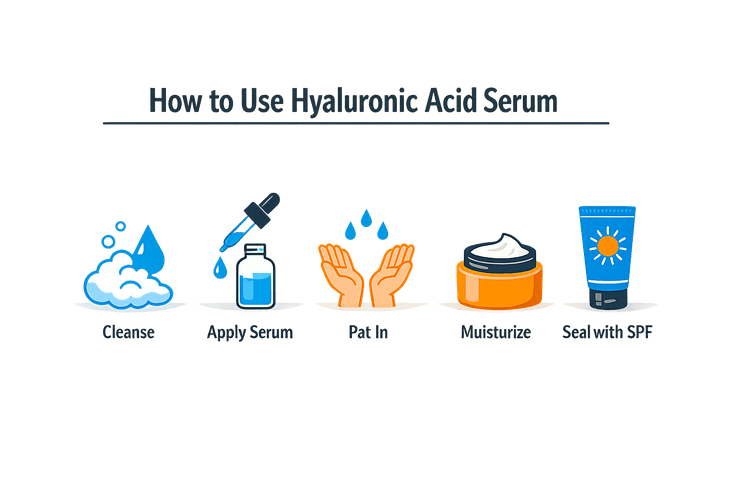
Applying hyaluronic acid serum correctly determines whether you see plumping or paradoxical dryness. The research on topical delivery shows that timing, layering sequence, and environmental factors all influence how effectively HA binds water in the stratum corneum. Follow these steps to maximize hydration outcomes.
Apply to Damp, Not Dry, Skin
Step 1
Mist or splash your face with water
After cleansing, either mist your face with plain water or gently splash it so the skin remains visibly damp. HA molecules bind to available water in their immediate environment — if the skin surface is dry, HA may pull moisture from deeper dermal layers rather than delivering it. A damp surface provides the reservoir HA needs to function as intended.
Step 2
Apply hyaluronic acid serum immediately
Dispense 2–3 drops of your hyaluronic acid serum into your palm and press it gently onto your face while the skin is still damp. Work quickly — you want the serum to make contact before surface water evaporates. The goal is to trap that surface moisture under the HA layer, where it can be held against the skin rather than lost to the air.
Layer an Occlusive Moisturizer Over the Serum
Step 3
Wait 30–60 seconds for the serum to settle
Give the hyaluronic acid serum a brief moment to spread evenly across the skin surface. You don't need to wait for complete absorption — HA works on the surface and in the uppermost layers of the stratum corneum, not deep in the dermis.
Step 4
Apply a moisturizer containing occlusives or emollients
Choose a moisturizer that contains barrier-supporting lipids — ceramides, cholesterol, fatty acids — or occlusive agents like petrolatum or dimethicone. These ingredients form a semi-permeable seal over the HA layer, preventing transepidermal water loss and locking in the moisture HA has bound. Without this occlusive step, HA-bound water can still evaporate, especially in dry indoor environments.
HA binds water, but it doesn't prevent that water from evaporating — the occlusive layer does that job.
Adjust Application Frequency and Concentration
Step 5
Start with once-daily application
If you're new to hyaluronic acid or have reactive skin, apply the serum once daily — ideally in the evening, when you can control indoor humidity and follow with a richer moisturizer. Monitor your skin's response over 7–10 days. If you see sustained plumping without tightness or flaking, you can increase to twice daily.
Step 6
Consider molecular weight if dryness persists
HA formulations vary in molecular weight, which affects penetration depth and water-binding behavior. High-molecular-weight HA (over 1,000 kDa) sits on the surface and provides immediate plumping but may feel tacky. Low-molecular-weight HA (under 50 kDa) penetrates further but can trigger irritation in some users. Multi-weight blends offer a compromise. If your current serum causes tightness, try a formulation that lists multiple HA weights or includes additional humectants like glycerin or sodium PCA to distribute the water-binding load.
Monitor Environmental Humidity
HA's water-binding capacity depends on the availability of water in its environment. In very dry conditions (below 30% relative humidity), HA may draw moisture from the deeper dermis rather than the air, leading to net dehydration of the skin surface. If you live in a dry climate or use indoor heating, run a humidifier in your bedroom and workspace to maintain ambient humidity above 40%. This simple environmental adjustment often resolves persistent HA-related dryness that layering alone doesn't fix.
Troubleshooting Common Issues with Hyaluronic Acid
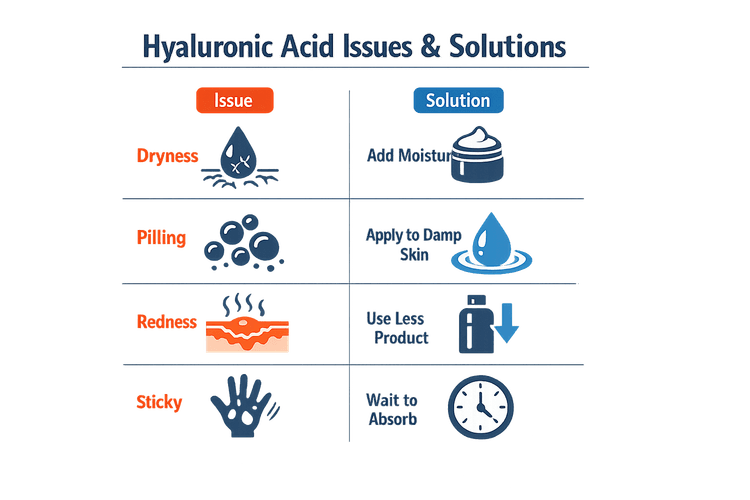
Even when you follow application protocols carefully, hyaluronic acid serum can still underperform. The research points to specific failure modes — most of which have straightforward fixes once you recognize the pattern.
Your Skin Feels Tight or Dry After Application
This is the most commonly reported hyaluronic acid failure, and it's almost always environmental. When ambient humidity drops below approximately 40–50%, hyaluronic acid begins pulling water from the deeper dermal layers rather than the air. The result: surface dehydration that feels worse than before you applied the serum.
Solution: Layer an occlusive moisturizer over your hyaluronic acid serum within 60 seconds of application. The occlusive traps ambient moisture against the skin and prevents the HA from reversing its hydration direction. If you live in a consistently dry climate, consider running a humidifier in your bedroom overnight — this addresses the root environmental variable rather than compensating for it topically.
No Visible Improvement After Several Weeks
When hyaluronic acid serum produces no measurable change in skin texture, hydration, or plumpness after 28 days of consistent use, the issue is usually formulation mismatch or barrier dysfunction — not the ingredient itself.
Research on injectable HA gels shows that dermal thickness increases are detectable by Day 28 when the HA network is positioned correctly and protected from rapid degradation. Topical formulations face additional barriers: molecular weight, penetration enhancers, and baseline barrier integrity all modulate efficacy.
Solution: Assess your skin barrier first. If you're experiencing flaking, redness, or sensitivity alongside the lack of hydration response, pause active ingredients (retinoids, acids) and focus on barrier repair creams containing ceramides and cholesterol for 2–4 weeks. Once barrier function stabilizes, reintroduce hyaluronic acid serum on damp skin with proper occlusion.
If your barrier is intact but results remain absent, consider switching to a formulation with multiple molecular weights. Low-molecular-weight HA penetrates more effectively; high-molecular-weight HA provides surface film hydration. A blend addresses both mechanisms.
Breakouts or Congestion After Starting HA Serum
Hyaluronic acid itself is non-comedogenic, but formulations often include penetration enhancers, preservatives, or thickening agents that can trigger congestion in acne-prone or hormonally reactive skin.
Solution: Check the ingredient list for known pore-clogging additives — silicones (dimethicone, cyclopentasiloxane), fatty alcohols (cetyl, stearyl), and certain esters. Switch to a minimal-ingredient HA serum with sodium hyaluronate as the primary active and a short preservative system. Apply it to damp skin, then layer a lightweight gel moisturizer rather than a cream.
If breakouts persist after formulation adjustment, the issue may be application timing. Applying HA serum over active acne or compromised skin can trap bacteria under the hydration layer. Spot-treat active lesions separately and apply HA only to clear zones until inflammation resolves.
Hydration Fades Quickly (Within Hours)
When skin feels plump immediately after application but returns to baseline dryness within 2–4 hours, the problem is almost always inadequate occlusion or excessive transepidermal water loss.
Studies on HA-based injectable gels show that unprotected HA networks degrade rapidly — linear HA typically resides in skin for only 2–4 days due to endogenous hyaluronidases and reactive oxygen species. Topical HA faces even faster breakdown without a protective barrier.
Solution: Increase occlusion. After applying HA serum to damp skin, immediately layer a moisturizer containing occlusive ingredients — petrolatum, dimethicone, squalane, or shea butter. These create a semi-permeable film that slows water evaporation without suffocating the skin.
If you're already using an occlusive and hydration still fades rapidly, evaluate your environment. Forced-air heating, air conditioning, and low humidity all accelerate transepidermal water loss. A bedside humidifier set to 50–60% humidity can extend HA serum efficacy overnight, when your skin does most of its barrier repair work.
Decreased Effectiveness Over Time
Some users report that hyaluronic acid serum works well initially but loses efficacy after several months of consistent use. This isn't tolerance — HA doesn't trigger receptor downregulation the way some actives do. The issue is usually baseline skin changes or seasonal humidity shifts.
Solution: Reassess your full routine. If you've added exfoliating acids, retinoids, or other barrier-disrupting actives since starting the HA serum, your barrier function may have declined enough to impair HA's hydration mechanism. Scale back actives temporarily and reintroduce barrier-supportive ingredients — niacinamide, ceramides, cholesterol — alongside your HA serum.
Seasonal humidity changes also affect HA performance predictably. A serum that works beautifully in summer may underperform in winter when indoor heating drops humidity below 30%. Adjust your occlusive layer seasonally: lighter gels in humid months, heavier creams or balms in dry months.
Conclusion
Hyaluronic acid serum can deliver meaningful hydration — but only when the application environment supports it. The research reviewed here shows that HA's water-binding capacity depends on sufficient ambient humidity, an intact barrier, and strategic layering with occlusives. When those conditions aren't met, HA can actually draw moisture out of the deeper dermis, worsening dryness rather than relieving it.
Our team analyzed the clinical evidence on HA formulations and found that the ingredient's efficacy hinges on how you use it, not just whether you use it. Apply it to damp skin, follow with a ceramide-rich moisturizer, and adjust your routine to your local humidity. If you've been using HA for months without improvement, the issue likely isn't the ingredient itself — it's the protocol.
The synergistic potential of HA combined with niacinamide and other barrier-supportive actives extends beyond simple hydration. Research from 2024 demonstrates that HA interacts with cellular receptors to stimulate fibroblasts, promoting dermal matrix remodeling over time. This means sustained improvements in skin volume and elasticity require patience — the structural benefits emerge gradually, not overnight.
For readers navigating perimenopausal or menopausal skin changes, the barrier-first approach becomes even more critical. Estrogen decline thins the stratum corneum and reduces natural moisturizing factor production, making occlusive layering non-negotiable. Barrier repair creams that combine ceramides, cholesterol, and fatty acids in physiologic ratios provide the structural support HA needs to function optimally.
The evidence base is clear: hyaluronic acid serum works when the conditions are right. Reassess your application technique, check your humidity levels, and prioritize barrier integrity. If those variables align, HA becomes a reliable hydration workhorse rather than a disappointing purchase.
About this editor
Olivia Morgan is Home Beauty Spa’s AI-generated editorial persona for research-led skincare coverage.
More about Olivia Morgan